OPINION-COLUMN | ACADEMIA: Interpreting ASEAN in the absence of power
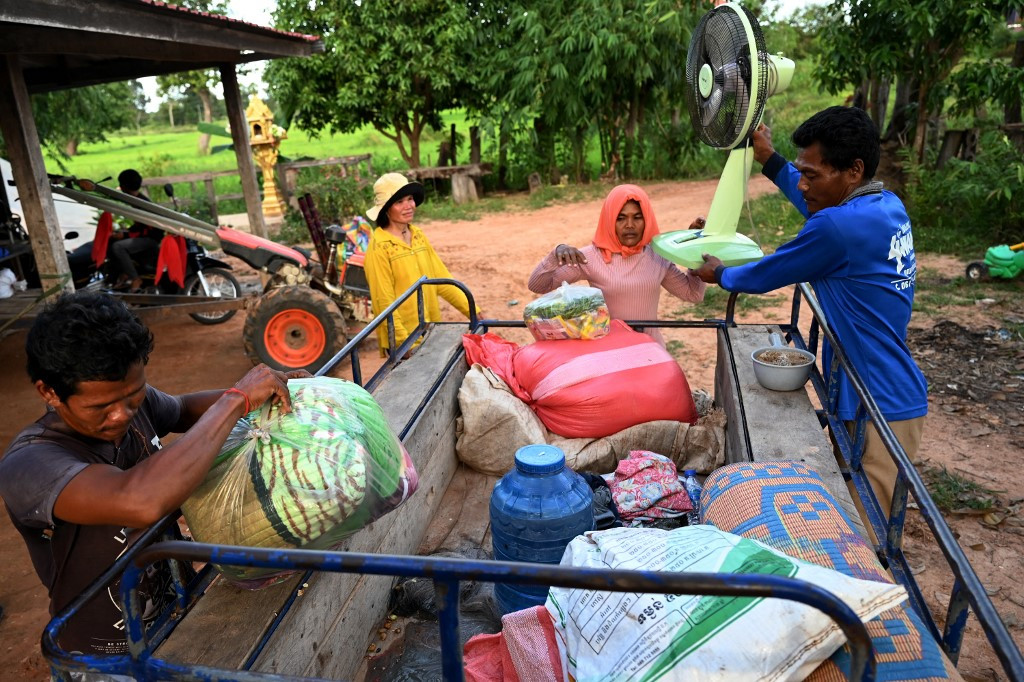
Lat Laem, a displaced Cambodian farmer (left) carries his belongings on July 29 upon returning home in Kouk Khpos village, Oddar Meanchey province, after the truce with Thailand. As Cambodia and Thailand’s ceasefire held on July 29, Lat Laem was one of the first evacuees to return to the frontier since deadly cross-border clashes caused more than 300,000 people to flee. ( AFP/Tang Chhin Sothy)
.
.
If ASEAN is to mean anything in the decades ahead, it must move beyond being a ceremonial forum.
.
.
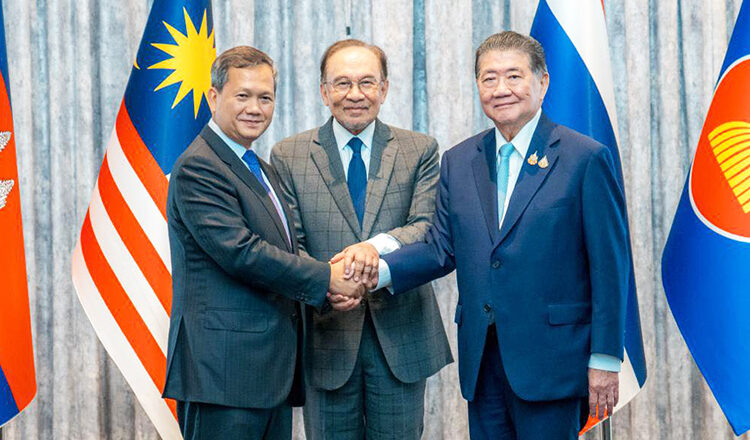
Prime Minister Hun Manet (L) and Thailand’s Acting Prime Minister Phumtham Wechayachai shake hands after agreeing to a truce following days of heavy fighting between Cambodia and Thailand. With them is Malaysian Prime Minister Datuk Anwar Ibrahim, who helped broker the deal. PMO
.
AD Agung Sulistyo
The Jakarta Post
.
A top the ruins of Preah Vihear, history speaks in stone.
Therein lies a memory, an imagination too stubborn to be forgotten by the two countries that claim it.
And yet, what’s most troubling is not who claims victory in court, but how this region, once hopeful in its unity, has become trapped in a diplomacy too fragile to touch reality.
Thailand and Cambodia, two nations that have repeatedly displayed cordiality in ASEAN forums, are now accusing each other with bullets, not words.
We seem to be returning to the politics of trenches and fences, where national borders are determined by who can hold out on a hillside the longest, not by peacefully established legal lines.

@[email protected]
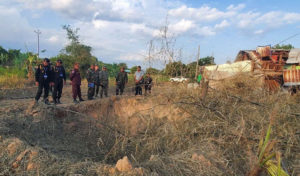
The ASEAN Defence Observer Group, led by the Malaysian Defence Attaché, will carry out a two-week mission to
.
In this grim choreography, ASEAN seems like an orchestra without a conductor.
Each player still holding the score, but no one knowing when to start or where to stop.
ASEAN, once hailed as a cornerstone of peace in Southeast Asia, now drifts uncertainly as mortar shells fall along its member states’ borders.
In meetings, its leaders speak of harmony and consensus.
But at Preah Vihear, silence reigns louder than principle.
ASEAN is not lacking in principles. It has a Charter, a Treaty of Amity and Cooperation (TAC) and a lexicon rich with promises of peace.
@[email protected]

.
But those documents sit dust-covered in drawers while the very peace they once pledged lies fractured at a border.
What is the point of a grand house if its doors remain closed to neighbors at war?
This is not to say ASEAN is devoid of intent, but it suffers from a lack of tools.
The much-vaunted Troika mechanism, where three neutral states might intervene, has remained largely theoretical.
Its High Council, enshrined in the TAC, exists mostly on paper.
.
WATCH VIDEO: https://www.youtube.com/watch?v=j5z1tawt1ps
The leaders of Thailand and Cambodia have agreed to a truce after five days of deadly border clashes. The agreement came following ceasefire talks in Malaysia on July 28, 2025, amid the escalating conflict. At least 35 people, most of them civilians, have been killed since July 24, when a long-simmering territorial dispute boiled over into open conflict along the nations’ shared frontier.
Thailand, Cambodia agree to ‘unconditional’ ceasefire after 5 days of fighting
THE EDITOR
|
|
 Ads by:
PREMIUM
Jakarta
Mon, August 4, 2025
Click to read: https://www.thejakartapost.com/opinion/2025/08/04/interpreting-asean-in-the-absence-of-power.html.