
ASEANEWS HEADLINE-VP Du30 IMPEACHMENT | MANILA: House appeals SC ruling on VP Sara impeachment
.
WATCH VIDEO: https://www.youtube.com/watch?v=DnrGUEBD5Ws
House appeals SC ruling on Sara Duterte impeachment case | INQToday
.
.

MANILA, Philippines — The House of Representatives has urged the Supreme Court (SC) to remain politically neutral as it asked the high tribunal to reverse its ruling striking down the impeachment of Vice President Sara Duterte.
In a 70-page motion for reconsideration filed through the Office of the Solicitor General yesterday, the House said it was not asking the SC to “favor any one political result,” but to allow Congress to perform the duties the Constitution asks of both its chambers – for the House to initiate an impeachment proceeding and for the Senate to try the case.
“The House asks this Honorable Court not to stand with a certain political faction or another, but to uphold the Constitution, which gives life to all the institutions of government, and with the people, who in turn, are the true sovereign and to whom all accountability, trust and power, are owed,” the motion declared.
The House argued that the high tribunal’s power of judicial review “cannot be used to modify clear and unambiguous provisions of the Constitution, intrude into the constitutionally vested powers of the Congress, needlessly burden constitutional mechanisms for upholding accountability of public officers and nullify legitimate actions which have been done in accordance with the existing legal framework.”
 |

It added that judicial review cannot reach into the internal proceedings of either the House or the Senate, to dictate that which the Constitution entrusts to each chamber’s discretion.
The House contended that the fourth impeachment complaint against Duterte, filed by at least one-third of the House, did not violate the one-year bar rule since it first acted on it and transmitted it to the Senate, prompting the termination or archival of the first three complaints.
It also said Duterte’s due process was not violated since this right was to be accorded to the impeached official before the Senate trial proper, as provided by the Constitution.
The new rules that the SC imposed on impeachment proceedings, the House said, are new standards that the chamber of Congress could not be held to prior to their creation as “it would simply be unfair.”
|
|
It also said the new rules on due process are not called for by the Constitution and “unduly interferes in the House’s own prerogatives to conduct impeachment proceedings,” saying the Constitution requires nothing else in the filing of a complaint backed by one-third of the House membership.
With this, it said it would be erroneous on the part of the SC to find the House to have committed grave abuse of discretion.
“The House does not ask this Honorable Court to be swayed by the politics of the moment, nor to abandon its rightful duty of judicial review. Rather, it only asks that this Honorable Court allow a co-equal body – the Congress – to perform its own duties under the Constitution,” the motion read.
|
|
The House also offered that impeachment, powered by the Constitution, “cannot be defeated by misguided interpretations or suffocating technicalities,” saying the political nature of it cannot be denied.
“Thus, any ruling of this Honorable Court on impeachment must reflect impeachment’s true nature. It must give due deference to the branch of government to whom impeachment is entrusted,” it said.
The House noted that certain errors and factual misunderstandings must be corrected, particularly to the sequence of the House’s actions on Feb. 5, 2025 when it transmitted the fourth impeachment complaint to the Senate, which subsequently served as the Articles of Impeachment and the timeline in which the first three impeachment complaints were included within 10 session days.
It also said the SC incorrectly concluded that the archival of the first three complaints was due to the expiry of the 19th Congress’ regular session, adding that the 19th Congress did not end on Feb. 5 but merely adjourned and the session would be resumed on June 2.
This, it said, did not make all matters pending at the time, including the impeachment complaints, “unacted upon,” terminated or dismissed.
In a separate statement, Speaker Martin Romualdez described the filing of the motion as “not an act of defiance or disrespect but an exercise in constitutional stewardship.”
|
|
“We act not to provoke a clash of institutions, but to prevent the erosion of the people’s right to accountability,” he said.
“What is at stake is far greater than mere procedure or timing. What is at stake goes far beyond the 20th Congress. What is at stake is whether the people retain their power to hold the most powerful officials in government accountable – through the very branch that speaks in their name,” Romualdez added.
.
‘Impeachment cannot cross over’

According to two Supreme Court justices, impeachment proceedings cannot cross over from one Congress to the next, arguing that complaints are deemed terminated when the term of a Congress ends.
In separate concurring opinions, Associate Justices Ramon Paul Hernando and Henri Jean Inting said both the House of Representatives and the Senate are not continuing bodies and that the new Congress is not bound by the acts of the previous Congress.
Hernando cited the rules of both chambers, which provide that all pending matters or unfinished business at the end of a Congress term are terminated.
|
|
.
He also said the SC had already ruled in previous decisions that the House is not a continuing body and the Senate, while continuing as an institution, is non-continuing with respect to its business and day-to-day matters.
While the rules of both the House and Senate, as well as the SC rulings, did not mention impeachment proceedings, Hernando said such principles can likewise be applied to impeachment cases.
“Binding the succeeding Congress to the acts of the previous Congress is tantamount to restricting or even disregarding the will of the people which was expressed anew in the conduct of elections. Casting a vote is the representation of the change or reaffirmation of the people’s will,” he said.
He also said “there is no reason” for impeachment proceedings to be classified differently from the other constitutional powers and duties that only the House and the Senate can perform, and therefore the House’s and Senate’s rules on “all unfinished business” and “all pending matters and proceedings” shall cover impeachment proceedings and pending impeachment cases.
With this, Hernando said the fourth impeachment complaint against Vice President Duterte, even if already transmitted to the Senate and served as the articles of impeachment, is terminated due to the expiration of the 19th Congress.
He, however, said the 20th Congress is not barred from initiating new impeachment complaints.
For his part, Inting said the Senate cannot conduct further proceedings on the impeachment against Duterte because it is not a continuing body.
|
|
.
He said that although the Rules of the Senate state that all pending matters may be taken by the succeeding Congress as if presented for the first time, this should not be allowed for impeachment cases as this would be a “legal impossibility” and “constitutionally impermissible.”
The impeachment trial likewise cannot continue beyond the term of the House that initiated the case, he said, saying the Senate is not constitutionally permitted to proceed with the trial from the House of the previous Congress that has “ceased to exist.”
He pointed out that the House acts as the prosecutor in an impeachment case, while the Senate acts as the tribunal.
“If an impeachment trial is allowed to proceed beyond the term of the House that created the articles of impeachment, it would result in an absurd situation where a previous House is able to bind the will of the present House,” he said.
The Senate also cannot continue with the trial because a conviction will require a two-thirds vote of sitting members and with the expiration of the Congress, only half of the senators will continue to the next Congress.
|
|
.
“The remaining members are less than a majority of the Senate and, hence, cannot constitute a quorum, much less render a judgment of conviction in an impeachment case,” Inting added.
Hernando and Inting issued their separate concurring opinions in the July 25 ruling of the SC that declared the impeachment unconstitutional for violating the one-year bar rule and Duterte’s right to due process.
The decision did not rule on whether an impeachment case can cross over to the next Congress.
.
‘Historic and emotionally charged session’
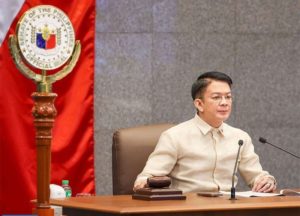
Senate Majority Leader Joel Villanueva said the chamber expects a historic and emotionally charged session today when it deliberates on whether to respect the SC ruling that effectively nullified the impeachment complaint against Vice President Duterte.
Referencing the July 29 all-member caucus that decided the Aug. 6 deferral, Villanueva said he expects debates as there were differing positions among members of the chamber about how to proceed with the impeachment trial.
“And I am looking forward to debates. Hopefully, the debates won’t be heated, or depending on how you define heated. But I think during that caucus, a lot of valid positions came out. And that’s why until now, we’re still doing our best to study all angles,” Villanueva told reporters yesterday.
|
|
.
Villanueva said he also expects voting on the matter tomorrow.
“So, it’s going to be an exciting day, I think, especially for the students of history, those who are fond of history… That, I think, is reflected on each member of the Senate that what we will decide upon is very important,” he added.
Some senators, including Minority Leader Vicente Sotto III, Senators Francis Pangilinan, Risa Hontiveros and Bam Aquino, have reportedly signed a resolution seeking the chamber’s support to call on the SC to reconsider its decision.
Referencing former chief justice Artemio Panganiban’s proposal for a status quo ante order and for oral arguments to be held, Pangilinan said the SC should use the motion for reconsideration filed by the House to prevent a constitutional crisis.
|
|
.
He said that all branches of government – including the Senate, House of Representatives and Supreme Court – must avoid being drawn into a “spiraling abyss of a constitutional war of attrition.”
“Such a conflict will only further erode the people’s trust in our democratic institutions and inflict lasting harm upon them,” he said in a statement.
At the backdrop of Pangilinan’s supposed resolution looms the Senate supermajority’s supposed inclination to follow the Court’s July 23 decision, with “19 to 20” senators opposed to continuing the trial as revealed by Senate President Pro Tempore Jinggoy Estrada.
Villanueva would not confirm the number, but acknowledged that political lines have begun to harden ahead of the floor debates.
He also revealed that while he originally believed the Senate should first convene as an impeachment court before tackling the Supreme Court decision, his stance changed after reading the 97-page ruling and consulting multiple legal experts – including retired and sitting justices.
“They’re helping us understand the implications of the ruling… I realized it is possible for us to discuss this without convening [as an impeachment court],” he added.
|
|
.
While the House filed a motion for reconsideration yesterday, Villanueva stressed that the Senate cannot use that as a reason to stall.
“If everyone will be heard and followed, I think the Senate does not agree that it won’t act on its own. I think we should be ready,” he said.
For his part, Sotto cautioned that the SC’s ruling effectively rewrites the rules of accountability for high officials and may render future impeachments “nearly impossible.”
“We may appeal to them (senators) to wait for the MR, wait for the decision of the motion for reconsideration. Because otherwise, if we decide on something and then the Supreme Court reverses itself, and it has happened before… they must not say that the Supreme Court does not reverse (a decision) if it is unanimous. What if it was a unanimous mistake? They do. They reverse themselves,” he said in an interview over ANC.
Similarly, Baguio City Rep. Mauricio Domogan called on the SC to rethink its position on Duterte’s impeachment, arguing that it is in contradiction to a 2003 SC decision in Francisco v. House of Representatives. In that case, the SC clarified that an impeachment complaint is “initiated” only when it is endorsed by the full House of Representatives to the justice committee, he said. — Neil Jayson Servallos, Artemio Dumlao

 Memento Maxima Digital Marketing
.
 HAPPY
HAPPY