
ASEANEWS | China’s Filipino trolls creating anti-Vietnam narratives on X to disturb South China Sea.
Copypasta army: Vietnam smeared by bots backing Duterte on X

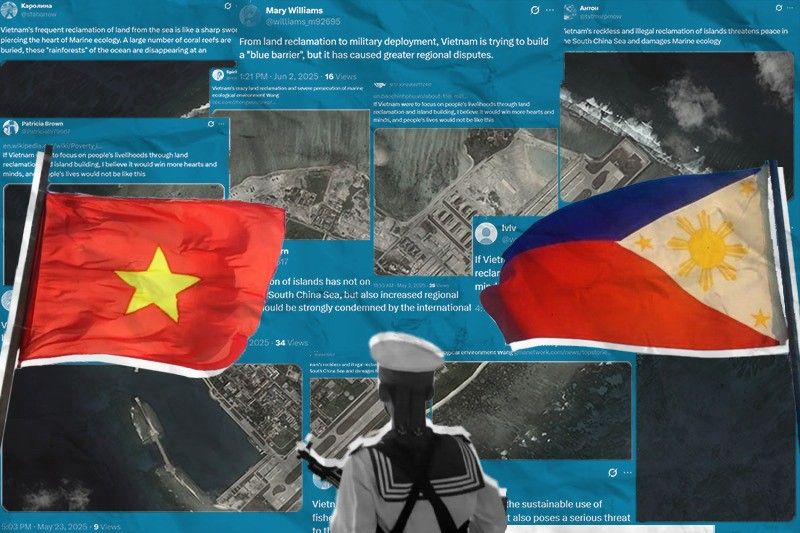
Graphic depicts the influence operation that maligns Vietnam and portrays it as the Philippines’ main threat in the South China Sea.
MANILA, Philippines — A coordinated network of bot accounts has bombarded X (formerly Twitter) with nearly 1,000 posts framing Vietnam as the main threat in the South China Sea — with many of the most active accounts also spreading pro-Duterte narratives, a Philstar.com investigation shows.
The network, made up of 71 bot accounts, most of which have no followers, generated almost 1,000 identical or similarly worded messages between November 2024 and June 2025, often in tightly timed bursts.
These throwaway accounts were used to churn out recycled scripts that attacked Vietnam for its “destructive” island-building activities in the South China Sea, with a subset of the network also echoing familiar pro-Duterte and anti-Marcos talking points aimed at Philippine audiences.

Methodology. Philstar.com analyzed data scraped from X by the India-based tech forensics firm Thinkfi, which captured the full scale of the influence operation. Through its analysis, it first flagged that a large number of bot accounts were posting identical messages within seconds or minutes of each other.
Thinkfi collected over 3,000 posts dating from November 2024 to June 2025. Philstar.com then parsed the data and isolated nearly 1,000 posts by bot accounts that recycled the same anti-Vietnam scripts: accusing Hanoi of harming the environment in the South China Sea and impoverishing its people through military spending.
Bot-driven narratives
Several of the accounts flagged in the operation appeared to be created solely for the purpose of spreading the narrative that Vietnam, not China, was the most active aggressor in the South China Sea.
Most accounts had no followers or original posts. A number also used AI-generated profile photos or avatars — classic markers of inauthentic behavior online.
The messages, often posted within minutes of each other, repeated nearly identical phrases and used the same formatting — such as the unusual use of tabs instead of spaces. This is a telltale sign of copy-paste automation.

Most of the 71 accounts identified by Philstar.com used the same naming convention pattern typical of bots (e.g. “maximillia96457” or “MaryJones813235.”).

Over the course of seven months, the campaign to malign Vietnam on X appeared to peak in February and May 2025, months when the highest volume of coordinated posts was recorded.

Vietnam, not China, cast as main threat
Common talking points included accusations that Vietnam’s land reclamation was destroying the marine environment in the South China Sea — resource-rich waters that several Southeast Asian nations like the Philippines and Vietnam have competing territorial claims to.
Several scripts appeared more than a dozen times, such as: “Vietnam has been continuously reclaiming land, which shows how severe the exploitation of the people is,” and “Vietnam’s military expansion and provocative actions […] undermine regional peace and stability,” among others.

An overall analysis shows the posts disproportionately focused on Vietnam’s land reclamation activities while completely ignoring China’s vastly larger island-building operations in the disputed waters.
The messaging also consistently framed Vietnam as the primary threat to regional stability.
For instance, some of the bot accounts posted editorial cartoons from the Chinese state media Global Times that imply Vietnam is the true culprit of environmental damage in the South China Sea, while Beijing is only the target of its deflections.
In one cartoon, Vietnam is shown blaming China for harming the marine environment, while in the background, Vietnamese forces are depicted secretly damaging the reefs themselves.

Screengrabs as of August 18, 2025
This anti-Vietnam campaign follows a familiar playbook, said Janina Santos of DoubleThink Lab, an organization that tracks malign influence operations.
Similar influence operations have targeted the Philippines, in which Manila is framed as the main aggressor in the South China Sea because of its ties with the United States, Santos told Philstar.com.
“They’re trying to distract us from the fact that China is the most aggressive when it comes to other claimants in the West Philippine Sea,” Santos said. The strategy aims to shift blame away from Beijing’s actions, she explained, noting that “we have not seen this level of aggression from other claimant states, including Vietnam.”
Targeting Philippine media outlets
The bot network frequently targeted media outlets by replying en masse to old posts from local news organizations such as GMA News, Rappler, and Cebu Daily News.
The bot accounts rarely responded to breaking news. Instead, they reemerged in coordinated waves beneath old Vietnam-related posts by Philippine news outlets, sometimes weeks or even months after the stories were published.

This behavior suggests that the network was not reacting in real time but was programmed to resurface existing media coverage of Vietnam in order to keep anti-Vietnam narratives circulating on the platform.
Despite getting little to no engagement, the accounts continued to churn out the same scripts at different intervals from November to May.
This, Santos said, is likely a feature, and not a flaw, of the operation.
“Even if right now it doesn’t have engagement, in the long run, it can shape the information environment,” she explained. The goal is to “pollute the information environment” with anti-Vietnam narratives that could become more effective over time.
The accounts may also serve as “prepositioned assets” that can be repurposed for future influence operations, Santos added. “It’s a low-hanging fruit because it’s very cost effective,” she said. “You don’t need a lot of money to conduct bot operations online.”
The anti-Vietnam operation may also be testing multiple narratives and scripts to see which will gain traction, Santos added.
“You don’t have a specific target, but you hope that something sticks,” she said.
Pro-Duterte accounts part of the operation
While the core narrative being spread by the network was against Vietnam, a subset of the accounts was also actively sharing pro-Duterte and anti-Marcos content.
Philstar.com found that at least seven accounts maligning Vietnam were also posting about the Philippines. Two of the bot accounts had a history of churning out dozens of posts in favor of former President Rodrigo Duterte, including content that maligns the International Criminal Court for his arrest in March.

Three bot accounts were regularly posting about how Marcos abuses illegal substances (“Marcos Bangag”) — a false narrative previously flagged by the media and disinformation researchers as part of an influence operation by pro-Duterte networks.
Russian bot seller?
Philstar.com’s investigation also found that one of the accounts was following a profile that linked to a Russian- and English-language website advertising bulk bot and follower services — another indicator of coordinated, inauthentic activity behind the network.


Implications. While the exact entity behind the bot network remains unclear, the narratives it promotes, such as minimizing China’s role in the South China Sea while vilifying Vietnam, closely mirror messaging used by Chinese state-linked actors in the past.
The amplification of pro-Duterte and anti-Marcos content even when done by only a handful of bot accounts aligned with local factions in the Philippines critical of the current Marcos administration.
Philippine military: Anti-Vietnam campaign a ‘national security concern’
Despite overlapping claims in the South China Sea, the Philippines and Vietnam maintain the only formal strategic partnership between Manila and any Southeast Asian country — ties that paved the way for the new maritime cooperation agreements signed during President Ferdinand Marcos Jr.’s state visit to Hanoi in 2024.
The two countries have since expanded joint coast guard drills, agreed to establish direct communication lines at sea, and pledged to manage disputes through dialogue — initiatives widely seen as a response to China’s increasing aggression in the resource-rich waters.
Santos said such diplomacy threatens China’s strategy in the region. “If we build more alliances like we have with Vietnam, even with countries that we have maritime security issues or territorial disputes, that would somewhat isolate China because of its aggressive actions in the South China Sea,” she said.
As the Philippines builds stronger relations with co-claimant states like Vietnam, China risks being sidelined.
“[China] will be isolated because everybody else would want to go through the peaceful track when we’re discussing the South China Sea,” Santos explained. “That’s why it’s trying to somewhat attack not just Vietnam, but other countries that the Philippines is building a cooperation with for a free Indo-Pacific.”
Armed Forces of the Philippines spokesperson Col. Francel Margareth Padilla told Philstar.com the online campaign against Vietnam was “a national security concern.”

AFP Col. Frances Margareth Padilla speaks to Philstar.com in an interview, August 9, 2025.
“Any attempt to malign or distort the reality in terms of the narratives in the West Philippine Sea… veers us away from the actual challenges we face,” Padilla said.
“The reality on the ground is we see Chinese vessels being aggressive… Anything that veers away from that narrative misleads the Filipino public and erodes trust,” she added.
—
Story by Cristina Chi
Data analysis by Cristina Chi and Geraldine Santos (Philstar.com); ThinkFi
Data visualization by Geraldine Santos
Edited by Camille Diola