ASEANEWS HEADLINE-Du30 ICC EJK CASE | MANILA: ICC rejects Duterte’s jurisdiction challenge
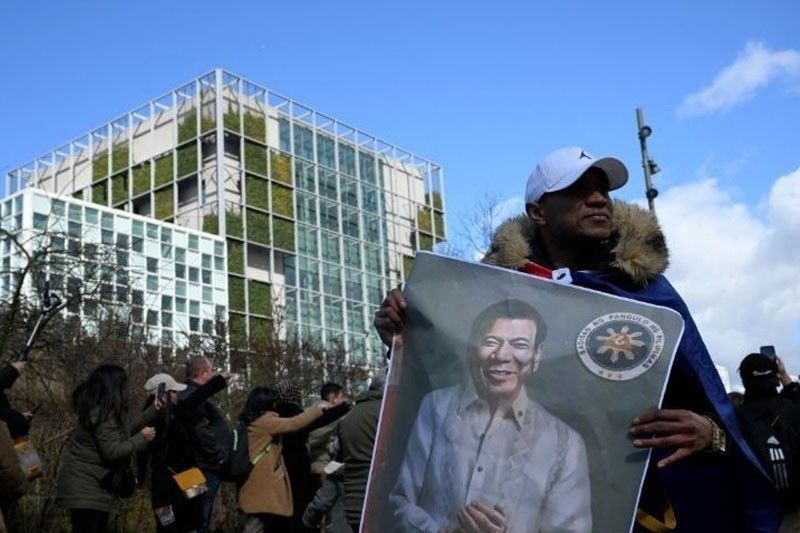
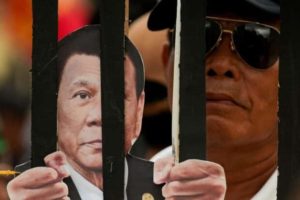
A man holds a portrait of former Philippines president Rodrigo Duterte in front of the International Criminal Court (ICC) where he will be appearing, in The Hague on March 14, 2025./ AFP / Nicolas Tucat
ICC Rejects Duterte Jurisdiction Challenge: Ex-President’s War on Drugs Case Moves Forward
.ICC Duterte Philippines war on drugs arrest International Criminal Court jurisdiction challenge Watch as we break down the latest developments in the International Criminal Court case against former Philippines president Rodrigo Duterte. Judges have rejected his challenge to the court’s jurisdiction, allowing the proceedings related to the deadly war on drugs to proceed. Key points from the ruling:
- Duterte was arrested in March and brought to The Hague on charges linked to murders during his anti-narcotics campaign.
- The ICC maintained jurisdiction despite the Philippines’ withdrawal in 2019, citing a preliminary examination as sufficient.
- Upcoming decisions on Duterte’s fitness to stand trial due to health concerns are expected soon.
Stay tuned for more updates on this high-profile case involving international law and human rights in the Philippines.
.
.

MANILA, Philippines — The International Criminal Court has ruled that it has the jurisdiction to prosecute former President Rodrigo Duterte for alleged crimes against humanity, rejecting his argument that the Philippines’ withdrawal from the Rome Statute in 2018 stripped the ICC’s authority over the case.
This defeats the Duterte camp’s main legal attempt to prevent an actual trial from taking place — leaving only the question of whether the former president, who has been held at The Hague since March, is fit to stand trial.
In a ruling released Thursday, October 23, the ICC Pre-Trial Chamber I unanimously dismissed Duterte’s legal challenge, finding that the ICC prosecutor’s preliminary examination launched in February 2018 — before the Philippines’ withdrawal took effect — was sufficient to preserve the court’s jurisdiction over Duterte’s alleged crimes.
The chamber “finds that the Court can exercise its jurisdiction in the present case over the crimes alleged against Mr Duterte that were committed on the territory of the Philippines while it was a State Party,” the decision read.
The chamber had determined that the Philippines’ withdrawal from the treaty that governs the ICC “shall not […] prejudice in any way the continued consideration of any matter which was already under consideration by the Court prior to the date on which the withdrawal became effective.”
.
Legal battle over withdrawal
.
The ruling centers on whether the Philippines’ withdrawal from the Rome Statute — which took effect March 17, 2019, one year after Manila deposited notification — severed the court’s jurisdiction over crimes allegedly committed on Philippine territory.
Duterte’s defense team argued the ICC lost jurisdiction when the chamber authorized the investigation in September 2021, more than two years after the withdrawal became effective. They contended that Article 12(2) of the statute requires a state to be a party “at the time that the Court exercises its jurisdiction.”
The defense further argued that a preliminary examination was too informal to constitute a matter “under consideration by the Court,” describing it as “internal, informal and non-justiciable” and potentially constituted by “even the most mundane acts.”

@[email protected]
The chamber firmly rejected those arguments, finding that preliminary examinations are “a statutory process which is a necessary precondition to seeking authorisation for the commencement of an investigation” regulated by Article 15 of the Rome Statute and rules 46-50 of the court’s procedural rules.
“The preliminary examination is not ‘too informal in nature’ to encompass a matter that is ‘under consideration’ by the Court,” the decision stated.
.
‘Direct relationship’ to withdrawal
The ICC Pre-Trial Chamber I also took note of the “direct relationship” between then-ICC Prosecutor Fatou Bensouda’s announcement of a preliminary examination in February 2018 and the Philippine government’s subsequent decision to withdraw from the Rome Statute — a decision that was done by then-President Duterte.
That announcement of the preliminary examination had explicitly stated that it would look into the crimes committed by Duterte since at least July 2016 in the context of the “war on drugs” campaign.
The Philippines deposited its withdrawal notification on March 17, 2018, just over a month later.
Media reports at the time cited Duterte calling ICC and UN scrutiny of his drug war campaign as “outrageous attacks.”
“This apparent action to avoid compliance with the Statute is what article 127 of the Statute, read as a whole, is designed to prevent,” the decision read.
@[email protected]
The court found that interpreting the statute to allow withdrawal to shield crimes already under examination “would be entirely against that object and purpose” and “go directly against the object and purpose” of preventing states from evading justice.
.
Scope of court’s authority
The ruling established that the term “the Court” in Article 127(2) includes the Office of the Prosecutor, one of four organs of the ICC alongside the judicial divisions, the Presidency and the Registry.
The chamber noted that the same sentence in Article 127(2) states withdrawal “shall not affect any cooperation with the Court in connection with criminal investigations and proceedings,” cooperation that includes requests by the prosecutor.
“It is the Prosecution that would be expected to be considering matters that form the subject-matter of preliminary examinations and investigations,” the decision stated.
@[email protected]
The ICC found that preliminary examinations can involve substantive judicial decisions, protection measures for victims and witnesses under Article 68(1), public announcements, and what the prosecution described as “an active and focused inquiry leading to a specific legal conclusion.”
.
Balancing withdrawal rights and accountability
The chamber acknowledged that ordinarily, once a state’s withdrawal becomes effective, it is “no longer bound by the Statute’s jurisdictional provisions.” Allowing jurisdiction decades after withdrawal would “fundamentally undermine the right of a State to withdraw.”
However, Article 127(2) “appropriately balances the right of a State to withdraw from the Statute with the overall objective of the Statute of putting an end to impunity,” the ruling stated.
The court emphasized that its finding does not mean every preliminary examination would preserve jurisdiction, noting that “each situation will need to be analyzed on its merits” and must be “approached with utmost caution to avoid any abuse.”
The confirmation of charges hearing has been postponed pending resolution of questions about Duterte’s fitness to stand trial.
Duterte is facing three counts of crimes against humanity of murder over the brutal and deadly “war on drugs” during his presidency and the years he was mayor of Davao City.
 Ads by:
 Memento Maxima Digital Marketing