

ASEANEWS HEADLINE- EDU | MANILA, Philippines: Functional illiterate Pinoys reach 24.8 million
Students walk across the gutter-deep flood along the corner of Taft and UN Avenues in Manila following a heavy downpour brought by the enhanced southwest monsoon on Monday, July 21, 2025. The city of Manila on Monday suspended classes at all levels in public and private schools starting at 12 noon.
Gatchalian: Functional literacy problem could make it difficult for graduates to find jobs | ANC
MANILA, Philippines — The number of functionally illiterate Filipinos has nearly doubled to 24.8 million in the past 30 years, the Second Congressional Commission on Education (EDCOM 2) reported.
In a statement, EDCOM 2 expressed concern over the Department of Education (DepEd)’s involvement in more than 261 interagency bodies, saying this has diverted the agency’s focus from its core mandate of basic education.
The commission recalled that in 1993, EDCOM 1 had urged the government to allow the department to focus solely on basic education to address the 14.5 million functionally illiterate Filipinos at the time.
However, despite the restructuring of education agencies since then, the number of functionally illiterate Filipinos has almost doubled, based on the 2024 Functional Literacy, Education and Mass Media Survey.

During a hearing on DepEd’s charter and mandates, Education Secretary Sonny Angara said the department currently sits in 261 interagency bodies, chairs at least 20 and attends 21 jointly with the Commission on Higher Education and the Technical Education and Skills Development Authority.
EDCOM 2 noted that while the first EDCOM sought to streamline DepEd’s functions – leading to the creation of agencies such as the National Commission for Culture and the Arts and the Philippine Sports Commission – more than 150 new laws and executive issuances since 2001 have added even more responsibilities to the department.
The commission also pointed out that the trifocalization of the former Department of Education, Culture and Sports in 1994, which created DepEd, CHED and TESDA, was meant to allow DepEd to focus on improving students’ functional literacy.

@[email protected]
EDCOM 2 executive director Karol Mark Yee said these additional mandates have burdened both the agency and schools, with teachers taking on non-teaching duties such as implementing vision screening under Republic Act 11358, coordinating compliance with the Pantawid Pamilyang Pilipino Program under RA 11310, managing feeding programs with the Department of Health and the Department of Social Welfare and Development, serving as Disaster Risk Reduction and Management coordinators under RA 10121 and overseeing the National Drug Education Program.
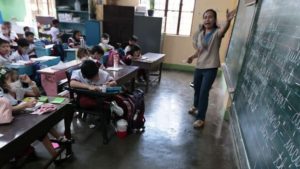
“These added responsibilities have aggravated the deficit of support staff in schools, forcing teachers to absorb ancillary and administrative work,” Yee said, adding that non-teaching tasks take up significant time and affect instructional quality and learning outcomes.
To address the issue, DepEd said it is streamlining interagency engagements under an education cluster within the office of the President’s Cabinet.
Since 1982, DepEd’s mandates have expanded significantly – covering 21 laws on curriculum and teaching, 10 on culture and civics, 18 on health and safety and hundreds of laws establishing or converting schools.
@[email protected]
EDCOM 2 also cited several unfunded education laws, including the Academic Recovery and Accessible Learning Program under RA 12028, the Alternative Learning System under RA 11510 and the Mental Health and Well-Being Promotion Act under RA 12080.
“We tried to calculate and do a rough estimate that if we were to fully fund all of the laws on education, it would cost over a trillion pesos,” Angara said. “So we’re trying to have a plan for that going forward.”
Equitable reforms

Aside from streamlining interagency engagements, the DepEd is also implementing equitable education reforms following the EDCOM 2’s recommendation to review its policy on the establishment of school division offices (SDOs) after a study revealed wide disparities in the number of schools supervised by each division.
EDCOM 2 earlier called for a review of RA 9155 or the Governance of Basic Education Act of 2001 to ensure equitable distribution of division offices and resources across the country.
The commission noted persistent disparities in the size of SDOs across the country. For instance, Leyte manages 1,363 schools and Cebu 1,346, while Caloocan City oversees only 319 and Batanes just 28.
In response, Angara said the department is pushing for a localized structure to make DepEd more responsive to the needs of learners.
He noted that Congress has recently adjusted funding priorities, reallocating some flood control funds to increase DepEd’s budget and expand investments in schools and teachers.
On Thursday, Angara led the inauguration of the SDO in Carmona City, which became a component city under RA 11938 in 2023.
@[email protected]
For years, Carmona’s schools were under the large Cavite Provincial Division, which oversaw 345 schools, making it difficult for smaller cities to secure timely support and resources.
“Carmona will now have its own SDO funds. It will surely help the teachers, employees and learners of the city,” Angara said.
Funded through a P30-million national subsidy under the financial assistance to local government units program, the new SDO Carmona will uphold the principles of transparent, ethical and accountable governance and promote accessible, inclusive and liberating basic education, Angara added.
Under Section 7 of RA 9155, every province or city is mandated to have an SDO superintendent tasked with supervising all teaching, non-teaching and administrative personnel within their jurisdiction.
Halloween protest

As the government pushes reforms, teachers’ groups reminded officials that true progress requires addressing the plight of educators themselves.
The Alliance of Concerned Teachers (ACT) Philippines yesterday joined other progressive groups in a Halloween protest at Mendiola, symbolically confronting what they called the “ghost of bureaucrat capitalism.”
With the theme “Trick or Threat,” the group denounced the government’s deception and intimidation of the education sector, as well as the persistent system of corruption, repression and neglect haunting the Filipino people.
“Trick is for unfulfilled promises. The government claims that education is a priority, but teachers suffer from low salary and problematic promotion systems and the classrooms are substandard. Threat is for the continuous red-tagging and harassment against leaders and teachers unions,” ACT chair Ruby Bernardo explained.
Bernardo also criticized Finance Secretary Ralph Recto’s proposal to make existing benefits tax-free without actually increasing them.
@[email protected]
“What’s the use of being exempt from tax when it’s not enough from the start?” she asked.
Bernardo added that the real “ghost” haunting public education is bureaucrat capitalism – a system that prioritizes kickbacks and profit over public service and protects the rich while abandoning teachers, students and ordinary citizens.
She reiterated ACT’s six urgent demands, including a P50,000 entry-level salary for teachers, P36,000 basic pay for education support personnel, doubling of the education budget and an end to corruption and state repression.
 Ads by:
 Memento Maxima Digital Marketing