ASEANEWS HEADLINE-ECONOMY | MANILA: Unprogrammed funds challenged before SC
Lawmakers urge SC to declare unprogrammed appropriations as unconstitutional | ANC
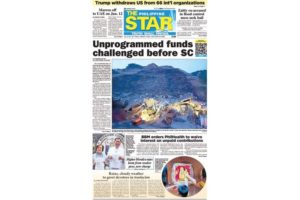
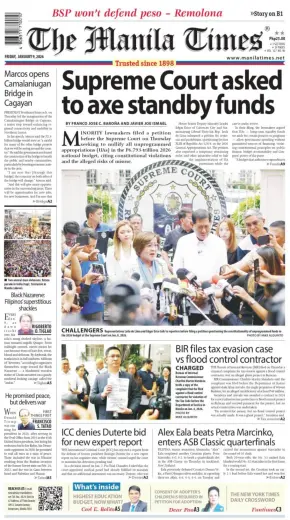
MANILA, Philippines — The constitutionality of unprogrammed appropriations in the 2026 national budget faces a challenge before the Supreme Court (SC) for allegedly being repugnant to the Charter and violating constitutional principles on public finance, budget accountability and Congress’ power of the purse.
Caloocan 2nd District Rep. Edgar Erice and Mamamayang Liberal party-list Rep. Leila de Lima filed a petition before the SC that sought to declare null and void Section XLIII of the 2026 General Appropriations Act (GAA), the provision containing the unprogrammed funds.
They also sought a temporary restraining order (TRO) against the implementation of the funds pending adjudication on the matter.
In their 41-page petition, Erice and De Lima argued that the inclusion of unprogrammed appropriations in the national budget was committed with grave abuse of discretion amounting to lack or excess of jurisdiction.
They said the allocations posed a serious threat to transparency, accountability, and the balance of powers in the government by allowing the expenditure of public funds without clear and existing sources of financing.
De Lima said the inclusion of unprogrammed funds in the national budget violates Article VII, Section 2 of the 1987 Constitution, stating a national budget should have clear and identified sources of funding, not just the programs.
“It is clear that this reduces the power of Congress,” she said in an interview.
President Marcos signed the GAA, Republic Act No. 12314, which set the national government’s budget for 2026 at P6.793 trillion, last Jan. 5. He, however, vetoed P92.5 billion in the allocation for unprogrammed appropriations and imposed certain conditions on other provisions to ensure that public funds will be spent on what they have been allocated for.
.
Ads by:

@[email protected]
.
Unprogrammed funds are standby appropriations that can only be funded when the government collects enough revenues during the fiscal year.
Erice and De Lima said Marcos’ veto of the P92.5-billion unprogrammed funds did not cure the GAA’s constitutional defects, as there is still P150.9 billion left.
“We need a categorical ruling now. The Supreme Court must interpret if unprogrammed appropriations are constitutional or not,” De Lima said.
The petition also cited violations of several provisions of the 1987 Constitution, including rules on the budget ceiling, contingent appropriations, and the proper allocation and disbursement of public funds.
It also flagged budget items such as teachers’ gratuity pay and local government shares in national taxes, which the lawmakers said should have been included under programmed appropriations as mandatory government obligations.
DBM defends UA
The Department of Budget and Management (DBM) has affirmed that unprogrammed appropriations under the 2026 budget are constitutionally valid, emphasizing they are strictly controlled standby funds, not a blank check.
In response to the complaint challenging the constitutionality of the 2026 unprogrammed appropriations before the SC, the budget department said they remain committed to upholding the Constitution and authority of courts.
“As previously upheld by the Supreme Court, the unprogrammed appropriation is a standby appropriation that may only be released upon the occurrence of clearly defined fiscal conditions and subject to strict validation and control mechanisms,” the DBM said.
The DBM said it has yet to receive an official copy of the petition. Once received, the department said it will review the petition and transmit it to the Office of the Solicitor General, the government’s statutory counsel.
“It also bears noting that the fiscal year 2026 unprogrammed appropriations amount to P150.9 billion, the lowest level since 2019, reflecting heightened fiscal discipline and reinforced safeguards in the current budget,” the DBM said.
.
Ads by:
@[email protected]
.
Unprogrammed appropriations that were retained in the outlay were the support to foreign-assisted projects with loan agreements expected to be finalized during the year (P97.3 billion), risk management provisions for unforeseen contingencies (P3.6 billion) and the revised Armed Forces of the Philippines modernization program (P50 billion).
“The DBM remains committed to upholding the Constitution, respecting the authority of the courts and ensuring that the national budget is implemented in a prudent, transparent and accountable manner,” the budget department added.
The vetoed items on the standby allocation for 2026 include budgetary support to government-owned and controlled corporations, prior year’s local government unit shares, certain industry support programs, insurance of government assets and some proposed government counterpart funding.
Deleting UA
Meanwhile, Sen. Erwin Tulfo yesterday vowed to push for the deletion of unprogrammed appropriations in next year’s budget amid concerns that the standby funds were being used for corruption.
Tulfo said he finds it impractical that the government allocates billions in standby funds for priority programs when it can only be tapped with excess non-tax revenue source or loans. He also questioned setting aside billions for unprogrammed funds, when the government does not always meet its revenue targets to have excess funds for the UA.
But Tulfo clarified that he was only against the UA items for projects that can otherwise be put in the programmed budget. He said there is a need for the UA item to assist the foreign-assisted projects.
.
Ads by:
@[email protected]
.
Meanwhile, Tulfo also said the proposed Joint Congressional Oversight Committee (JCOC) on Public Expenditures should have the power to do ocular inspections of flood control and other anomalous infrastructure projects.
During the Kapihan sa Senado forum yesterday, Tulfo welcomed the move to activate the JCOC being pushed by his colleague Sherwin Gatchalian, a joint congressional committee mandated in the GAA to have oversight on the use of public funds.
But Tulfo cautioned about relying on the reports and statements of government executives in agencies under scrutiny of the JCOC.
He cited the Senate Blue Ribbon committee probe findings that Cabinet secretaries, undersecretaries, and their directors were in cahoots with lawmakers to allegedly earn kickbacks from anomalous public works.
Tulfo said the JCOC should narrow down the projects that it can inspect for any anomaly and make random inspections to check on corruption.
According to the budget law, the JCOC would also be tasked to monitor the implementation of the “anti-epal” general provision, which expressly prohibits politicians from being involved in the distribution of government financial assistance programs. – Marco Luis Beech, Marc Jayson Cayabyab