
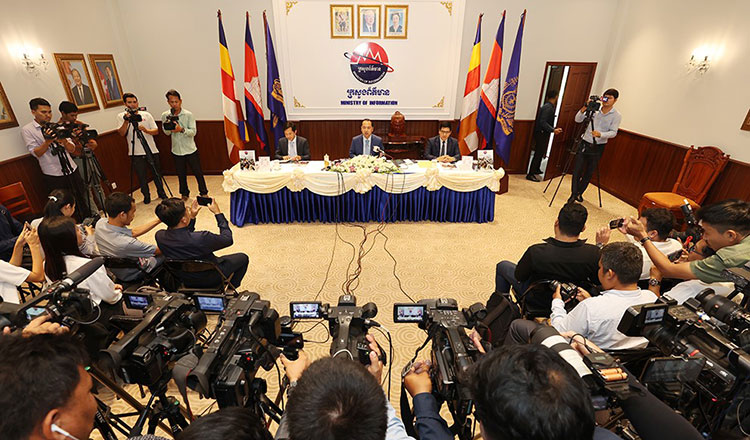
OP ED EDITORIAL | Journalists are not enemy of the state
.
Editorial
April 7, 2025

Except for some foreign or foreign-funded predatory journalists with malicious hidden agenda, government institutions should not treat journalists as strangers to public affairs or even enemy of the state.

Journalists are informers to the public about issues facing the current society.
“No comments” answer to the press is outdated.
Without adequate information, journalists cannot write to inform the public.
If professional journalists cannot inform, that would create vacuum for unprofessional media, especially those who use social media to create sensation, to arbitrarily interpret and create stories that are not factual or not based on real technical expertise.
Ministries and agencies should not shy away from the media. They need to keep feeding information and facts to media and respond to the media in a professional way.
Ministries and agencies should not blame the media or general public for lack of understanding but should make efforts to explain why specific policies and actions are taken or launched.
Not just issuing statements of self-protection when there are negative feedbacks from the public.
Ministries and agencies have to be patient and explanatory to the media without keeping accusing media as not being knowledgeable about the issues, and eventually choose to stop talking to media.
Ministries and agencies need to understand that if journalists as “the writers” do not understand the issues, the public as “the readers” also do not understand the issues.
Educating the media is educating the public about the subject matters.
Ministries and agencies should make efforts to provide aide-memoires, transcripts, data and facts, statistics preferably in written form, to avoid misquote or misrepresentation of the matters.
Except for sensitive data, general data and statistics related to activities and performance of the ministries or those related to the general conditions of specific sector should be made available online for public consumption, without the public or journalists having to ask for them or make official requests.
Ministries and agencies have to be patient and kind when talking with the media because talking to the media is no difference from communicating with the public.
They have to be more open and welcoming to journalists.
But they should not bribe journalists for favorable reporting.
.
Jailing the journalists instead of investigating the accused companies
Recently, there was a strange news about journalists being arrested for extorting money from companies that polluted public water in exchange for not revealing this information to the public.
In this case, the attitude of the public authority is very wrong.
Instead of investigating the issues first, the public authority arrested the journalists first.
Actually, both sides need to be punished but when comparing the level of impact to the public, the authorities should take actions against the companies first by suspending their activities and investigating whether what the journalists intended to report were facts.
When public authorities arrested the journalists first, it means that the authorities are prioritizing private interest of the companies and ignore the much larger public interest related to contaminated water system.
Such attitude should be changed, and journalist’s reporting should receive priority similar to public complains.
State institutions should investigate and study about the issues, not arresting or punishing journalists for reporting about issues of public interests and public concerns.
Equally important, journalists should observe strict ethics and code of conduct with regards to their reporting and should take responsibility of their reporting towards the public as well.
They cannot take rumors as source of information and then accuse specific public individuals, defame them and seek personal interest through bribery and extortion.
.
Government’s source as a reliable source of information
There has been good development such as institutionalization of spokesperson for each specific ministry and agency. These entities are responsible in providing public responses about their sectors.
Previously, every issue had to be responded by the prime minister or the Council of Ministers.
It is no longer the case.
But the problems now lie in the nature of their responses.
Mostly, the tone of the statements is accusatory and insulting to those who raised the issues, emotional, and some statements are very long, look like a personal letters or partial novels.
In such condition, the public will not read the government’s statements as a source of information anymore.
The government will lose credibility and the public will inevitably believe that what was reported is being true.
This is the negative backlash when the nature of the government’s statements is too defensive, accusatory, and insulting without presenting facts.
Being defensive and in denial position has no credibility in public diplomacy. People will stop reading government’s sources anymore.
The ministries and agencies should not rush to reject everything. They should investigate first, and issues statements based on the results of those investigations and facts.
Statements should be objective and the presentation of facts so that the public can judge by themselves and balance their thinking by considering information from various sources.
.
.
Colorful media instead of beautiful media
Naturally, society is not perfect but if all the news is beautiful, that society is unnatural.
Showing Cambodia as good as heaven or as bad as hell, either extreme does not serve Cambodia well, does not serve public interest in trying to convey facts, and does not make positive contribution to healthy development of Cambodia.
Ministers’ private activities are not news.
Too much good news is boring, and not intellectually stimulating. People will stop reading if they hear the media sing the praise to the government all the time because everyone knows that government is not perfect. There are good officials, and there are also bad officials.
When you read the news that is too beautiful and always beautiful, you are intellectually less stimulated. You can become weak-minded.
When you read the news that is too negative and always negative, you are over-stimulated. You can have heart-attack or anger management issues.
When asked which source of government’s media you read and listen to, Cambodian people might have no clue.
Some says that Freshnews is a major source of news but some says that they fed up with reading congratulatory and condolence messages that take the bucket list of articles of Freshnews.
It is not a hidden truth anymore that no one is watching TVK, reading AKP or listening to state radio. Sometimes people have no choice but to listen to foreign-funded anti-government radios in trying to find out what is going on in society.
This condition has to be changed.
The media needs to have courage beyond political agenda by showing both good and bad sides of Cambodia.
The media has a responsible mission to bring to the public the real concern of the people. Not just creating noises to serve specific political agenda or to seek commercial benefit. They have an important mission to bring real voices and concern of the people for public awareness and stimulate public discussion to seek solutions to the issues.
Such a healthy media development would lead to a healthy public education on state affairs, and ultimately lead to the betterment of Cambodian society.
.
THE EDITOR

 ADS by:
Memento Maxima Digital Marketing
@[email protected]
SPACE RESERVE FOR ADVERTISEMENT
.
Related Posts
-
 December 4, 2024
 -
 December 27, 2024
 -
 July 19, 2024
 -
 November 12, 2024