OP ED OPINION EDITORIAL | Democracy, 27 years later
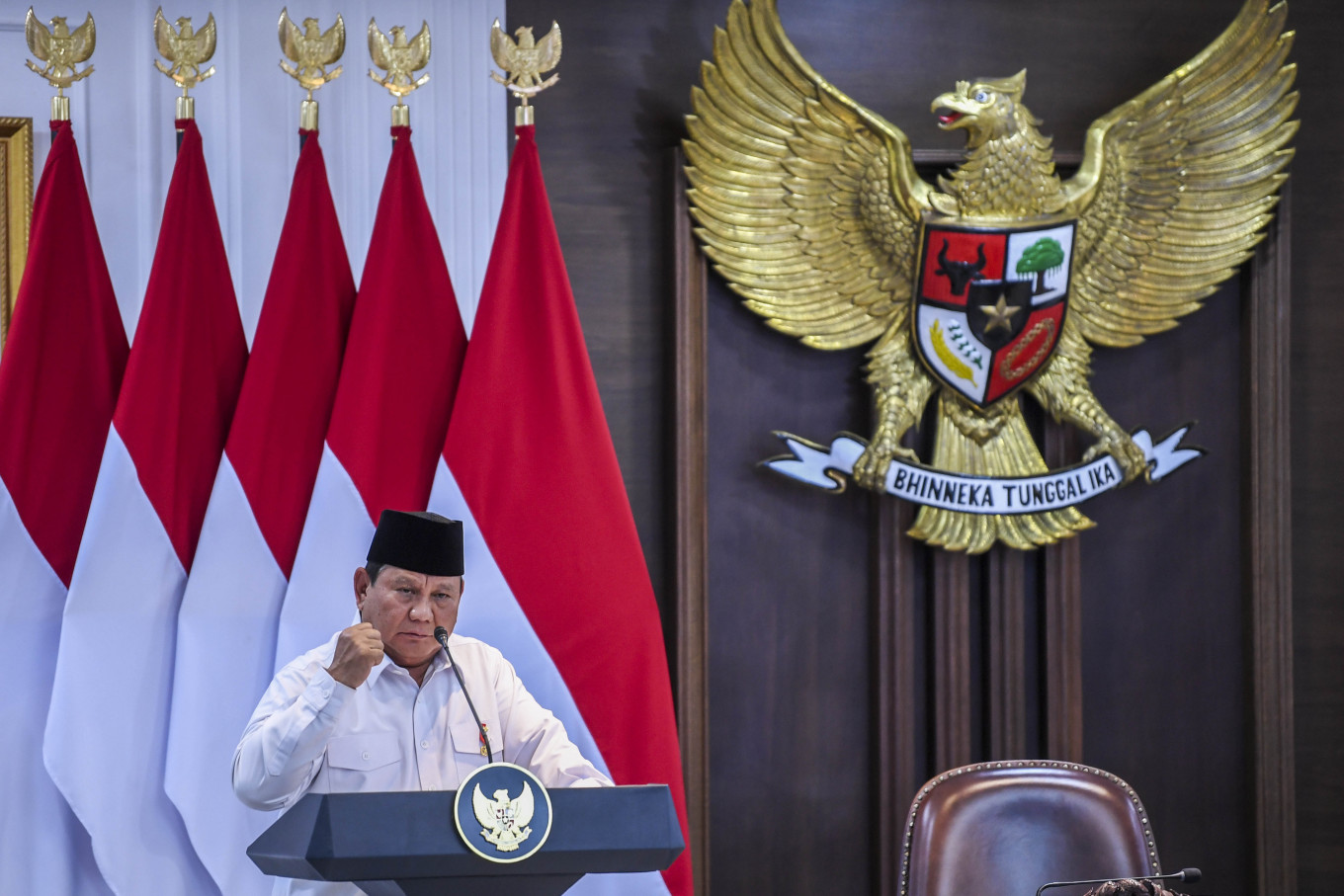
President Prabowo Subianto gestures while addressing cabinet members during a meeting at the Presidential Office in Jakarta on May 5. In the meeting, Prabowo asserted his authority amid perceptions of growing influence of former president Joko “Jokowi“ Widodo. (Antara/Galih Pradipta)
.
.
The shadow of Soeharto’s past now seems to loom over the nation, threatening the civilian supremacy we fought so hard to establish.
.
Editorial board
The Jakarta Post
 T oday marks the 27th anniversary of a pivotal moment in Indonesian history. On May 21, 1998, our nation demonstrated its collective power by forcing Soeharto to end his 32-year authoritarian rule.
.
This milestone achievement, which The Jakarta Post recorded in its memorable headline “I QUIT”, paved the way for Indonesia to become the world’s third-largest democracy in less than a decade. However, the shadow of Soeharto’s past now seems to loom over the nation, threatening the civilian supremacy we fought so hard to establish.

@[email protected]

.
Just one year after Soeharto’s fall from grace, Indonesia surprised the world with its first democratic elections, which were held in a free and peaceful manner. This commitment to democracy deepened in 2004 with the adoption of direct presidential elections, followed a year later by direct regional head elections.
.
Indonesia stands as a remarkable example, likely the only predominantly Muslim nation that has consistently proven Islam’s compatibility with even the most sophisticated democratic systems. In many other Islamic nations, democracy remains fragile or is even suppressed in the name of religion.
@[email protected]

.
Indonesia now confronts the danger of a complete reversal in its democratic trajectory. While in 1998, the military was largely seen as the primary cause of political and economic instability, a growing number of civilians now view the Indonesian Military (TNI) as a potential savior amid rising frustration with civilian governments at both central and regional levels.
.
However, the public must remember that any return of the military to public life should be for limited and ad hoc purposes. We must acknowledge that Indonesia’s largely Army-centric military currently faces no significant external security or defense threats. As an archipelagic nation, the Navy and Air Force should naturally play more strategic roles.
@[email protected]
.
It is unrealistic to expect the military to simply remain in their barracks when they have little to do. So, what is a solution that upholds the strict principle of civilian supremacy while being acceptable to all?
.
The public is increasingly weary of seemingly rampant abuses of power by state officials and political elites. They are also fed up with the corrupt and abusive behavior of the police. Consequently, many desire the military to step out of the barracks and reengage in social-political affairs.
.
President Prabowo Subianto, a former son-in-law of Soeharto, has repeatedly pledged to strictly abide by the Constitution, including upholding democracy. We trust the President’s commitment, and we believe his government will be stable, given that his ruling coalition controls over 80 percent of the House of Representatives.
@[email protected]
.
The end of Soeharto’s regime remains an unforgettable event for Prabowo, as just three months after the former’s resignation, Prabowo himself was dismissed from the military. Furthermore, Prabowo has often been linked to atrocities, including the abduction of government critics, although his case was never brought to justice.
.
The sweeping reforms removed the military’s privileges, recognizing that Soeharto had used the institution to cling to power. In 2004, the House of Representatives passed the TNI Law, primarily outlining its duties for external security and defense, with tight restrictions on military personnel holding civilian positions.
@[email protected]
.
However, in February of this year the House endorsed a revision of this law that allows the military to reclaim some of its old power. The government insists that the revised TNI Law only focuses on three main issues: expanding military operations other than war, increasing civilian posts that can be held by active TNI personnel and changing soldiers’ mandatory retirement age. This assurance, however, has not been enough to quell public skepticism.
.
After nearly three decades, there are convincing signs of the state’s temptation to revert to the Soeharto era, when stability was the currency. The election of Prabowo, in particular, has clearly become a significant moment for the military to potentially regain lucrative power in social-political affairs.
Precisely 27 years ago, Soeharto stepped down after nationwide protests. May this day serve as a clarion call to the nation, reminding us all that we must never abandon the vibrant tapestry of democracy which was woven with our blood and tears.
.
THE EDITOR
|
Numero Uno
|
 Ads by:
.,
Jakarta
Wed, May 21, 2025
.
.