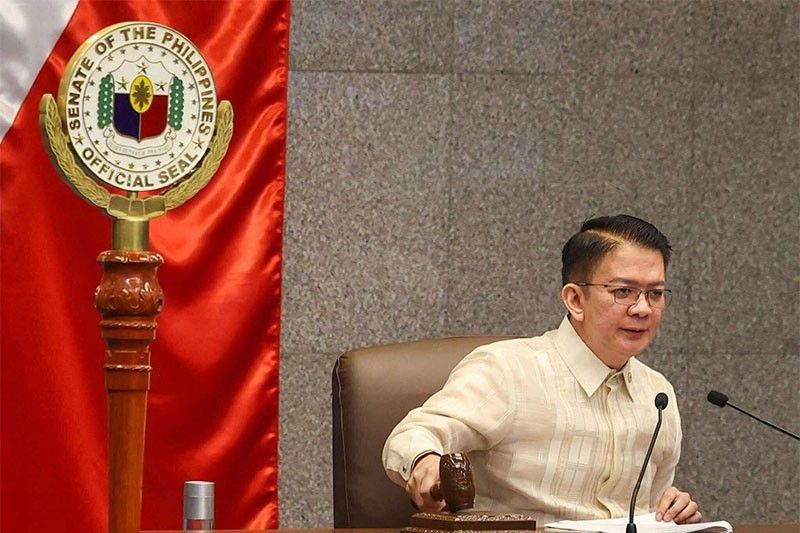
ASEANEWS HEADLINE | MANILA: Senate President Francis “Chiz” Escudero asserts budget power of Congress
.
WATCH VIDEO: https://www.youtube.com/watch?v=Bsi2dDPYMwk
‘No rubber stamp’: Escudero asserts Congress’ budget power after Marcos warning in SONA
Headstart: Senate President Francis “Chiz” Escudero on Wednesday said Congress could not automatically approve the proposed budget of the executive branch and asserted that the legislative body has the “power of the purse.”
.
.
MANILA, Philippines — Senate President Francis Escudero yesterday asserted Congress’ constitutional authority over the national budget, saying the administration cannot always get its way and make a rubber stamp of Congress.
In his State of the Nation Address (SONA) on Monday, President Marcos warned that he would veto the 2026 budget if it would be deemed not fully aligned with the executive’s priorities.
“While I agree that the administration has the prerogative to pursue its proposed budget, under the Constitution, the power of the purse still belongs to Congress,” Escudero said in an interview with ANC’s “Headstart.”
Escudero said the Senate would not hesitate to introduce amendments to the budget based on consultations and input, adding that while the House of Representatives may choose otherwise, the Senate intends to exercise its oversight role independently.
“If the House is willing to do that and it seems to be afraid to do that, then that’s their call. But on the part of the Senate, we will review the budget and we will propose amendments that need to be proposed,” he said.
He also called on the executive branch to set an example by restraining its own agencies from lobbying lawmakers for additional funds during the budget season.
President Marcos told Congress during his SONA that he would not sign a budget “not aligned with the vision of the administration,” a statement widely seen as a warning to lawmakers to keep amendments within limits.
Marcos made the remark after admitting that some of the country’s flood control projects are substandard. He vowed to press charges against those involved in irregularities that worsened the effects of recent cyclones.
year term.
 |
.
Asked if he felt alluded to amid reports tying him to corruption related to flood control projects, Escudero replied “no,” claiming there are no members of the Senate who are government contractors or suppliers.
“I didn’t feel alluded to because you have to remember there is no one in the Senate who is a contractor or supplier or at the same time a member of the upper chamber. I don’t think I can say or we can say the same for the House of Representatives,” he added.
Open bicam
For his part, Sen. Panfilo Lacson renewed his call to open bicameral conference committee hearings on the national budget to the public, saying while this could not fully prevent the insertion of “pork barrel” funds, it would help easily determine the lawmakers who would attempt such insertions.
Lacson is also pushing for longer periods for the Senate to review the House’s amendments to the National Expenditure Program (NEP), and for Congress to review and revise the budget bill if it gets vetoed by President.
“It is still possible that some insertions could be made, but at least we can identify those who did so for their projects. We can track the differences between the General Appropriations Bill and the National Expenditure Program, with the public observing and with minutes and transcripts of the proceedings,” he said in Filipino in an interview on Bombo Radyo Philippines.
year term.
|
|
.
Lacson has also proposed that lawmakers be given more time to enroll and review the budget bill so that if the President vetoes it, they can review and resubmit it for the President’s signature before Dec. 31.
“We need ample time to enroll the budget bill and to review and re-enroll it if the President vetoes it. The deadline is Dec. 31. If the President doesn’t sign it by that date, we automatically have a reenacted budget on Jan. 1,” he said.
For Sen. JV Ejercito, Congress should prioritize the passage of Senate Bill No. 1, which seeks to provide a P74.4-billion supplemental subsidy to Philippine Health Insurance Corp. (PhilHealth), warning that delays would undermine the full implementation of the Universal Health Care (UHC) Law.
“I hope the UHC is really given importance. The law is there, and what’s lacking is aggressive implementation – and funds,” Ejercito, principal author of the UHC Law, said.
The senator stressed that additional funding for PhilHealth, along with allocations for government hospitals, is necessary to sustain reforms such as the zero balance billing policy, which promises no out-of-pocket expenses for patients admitted in Department of Health hospitals.
While welcoming President Marcos’ mention of zero balance billing in his recent SONA, Ejercito criticized the slow pace of UHC implementation even if the benefits highlighted by the President —free consultations, cancer screening and zero balance billing—have long been part of the law’s provisions.
No additional request
Meanwhile, Budget Secretary Amenah Pangandaman said the Cabinet has reached a consensus to halt all further requests for additional allocation.
“That was the agreement of the full Cabinet, that no one would make further requests, no changes, nothing, because there was enough time to thoroughly review and finalize the budget during earlier discussions,” Pangandaman said in a radio interview.
She emphasized that the national budget operates on a zero-sum principle, meaning any increase in funding for one government agency would require a corresponding cut from another, as the total budget ceiling has already been firmly set.
year term.
|
|
.
For 2026, the budget proposed is P6.793 trillion, which is a 7.4 percent increase from this year’s budget of P6.326 trillion. The national budget is equivalent to 22 percent of the country’s gross domestic product.
While the Department of Budget and Management is setting its sights on drafting formal guidelines to manage a reenacted 2026 budget, Finance Secretary Ralph Recto remains optimistic that Congress will pass next year’s national appropriation on time.
“I don’t expect a reenacted budget because I expect cooperation from Congress. That is essentially what the President is saying, that as much as possible you can amend the budget, but let’s make sure we have the same priorities spelled out in the NEP,” he said.
In a post-SONA report, President Marcos said his administration continues to implement “effective” debt management that safeguards future generations against extreme debt burden.
“Ensuring that borrowings support productive investments and expenditure while maintaining fiscal sustainability allows the economy to grow faster compared to its obligations,” he said. – Marco Luis Beech, Helen Flores, Gilbert Bayoran

 Memento Maxima Digital Marketing