ASEANEWS HEADLINE: DU30’S CRIME AGAINST HUMANITY | MANILA: Videos, photos, 8,000 pages: More evidence vs Duterte
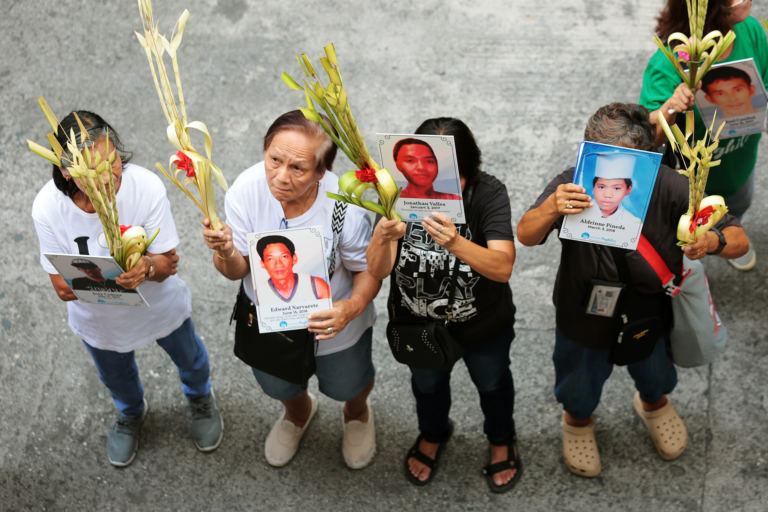
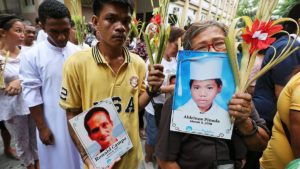
PRAYERS FOR JUSTICE Relatives of drug war victims join prayers for justice for their loved ones on Palm Sunday at the Arnold Janssen Kalinga Foundation in Sta. Cruz, Manila. —Grig C. Montegrande | Philippine Daily Inquirer
.
WATCH VIDEO: https://www.youtube.com/watch?v=5MqxIV_H8Dc
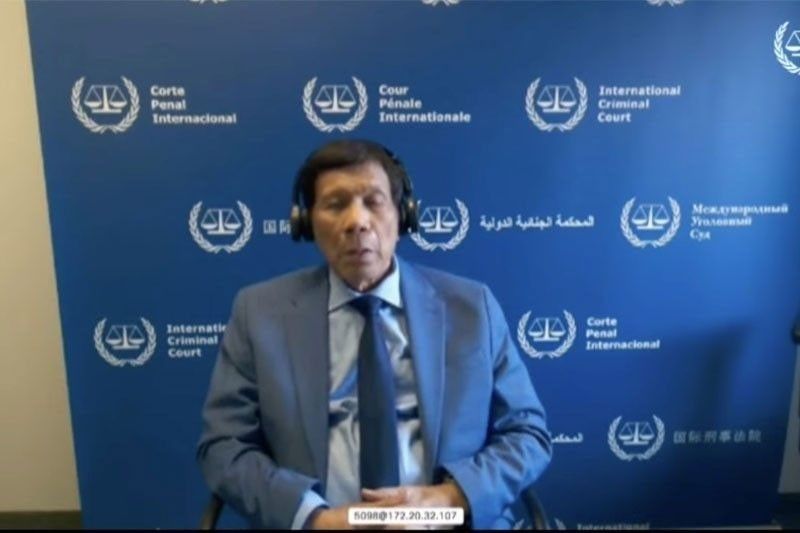
FULL HEARING: Ex-PH President Duterte faces ICC for first time | ANC
.
ICC prosecutor: Witnesses vs Duterte need protection
…
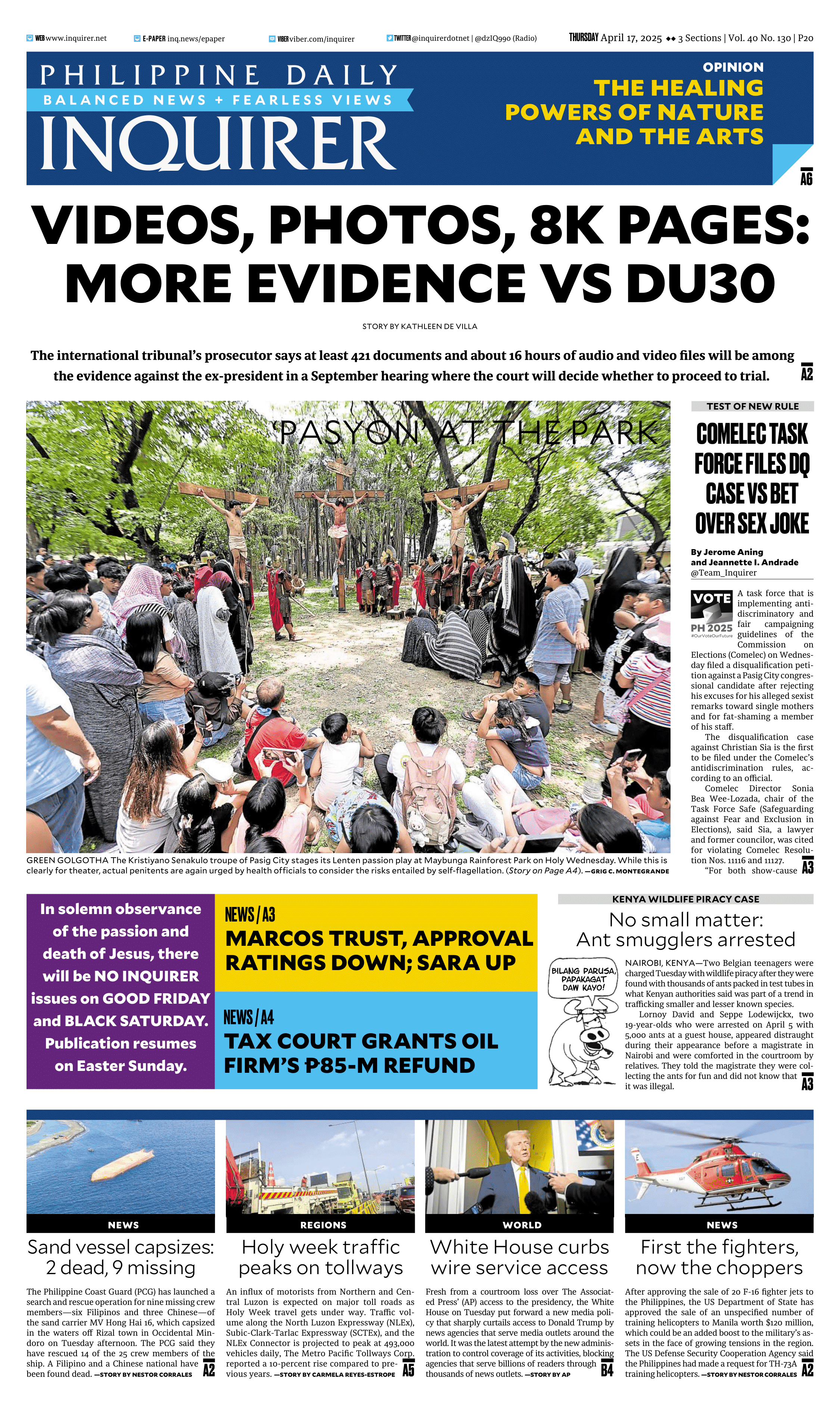
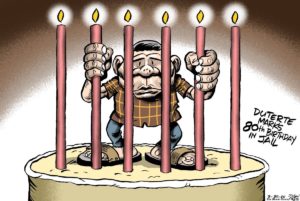
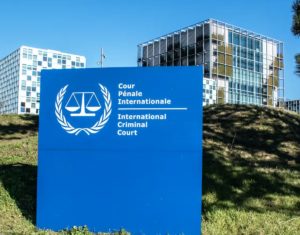
MANILA, Philippines — The prosecutor of the International Criminal Court (ICC) said it has at least 421 documents, nine photos, and nearly 16 hours of audio and video files that it would use as evidence against former President Rodrigo Duterte when he faces the tribunal again in September.
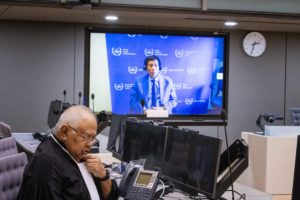
These were among the details of the evidence that the prosecution had at hand in its response to an order by the Pre-Trial Chamber 1 of the ICC to disclose information ahead of the confirmation of charges hearing on Sept. 23.
The confirmation of charges would determine whether the court would proceed with the trial of Duterte for murder as a crime against humanity in connection with his war on drugs, the signature campaign of his presidency that led to thousands of alleged extrajudicial killings.
READ: ICC lawyer schools Duterte’s lead counsel on drug war victims
|
|

.
In an April 4 document filed with the ICC, the prosecution, led by Karim Khan, said that it was “still in the process of determining the overall quantity of written and non-written documentary evidence that it intends to rely upon at the confirmation hearing.” The document, with redactions, was made public on the ICC website on Wednesday.
8,565 pages
Khan noted that the “majority of the evidence” will comprise those cited in its application for an arrest warrant, which included 421 pieces of written evidence, equivalent to 8,565 pages; nine photographs; and almost 16 hours of audio and video recordings.
Khan did not specify the contents of the documents, pictures, videos and audio recordings.
|
|

He said that the prosecution would likely use more evidence gathered in the course of the investigation of the drug war killings—a huge pile of approximately 168,575 items that had either been reviewed or were still under review.
All of the written or spoken evidence are in English, Filipino or Cebuano, he said.
|
|
“The prosecution will ensure all material is made available in its original language, with a transcription [or] translation into English where necessary,” he added.
Earlier submissions
On March 28, the prosecution submitted to the defense 181 items, equivalent to 2,878 pages of evidence implicating Duterte in allegedly masterminding an antinarcotics campaign that supposedly could curb the proliferation of illegal drugs in the country.
Evidence against Duterte started to surface after allegations of “continuing mass murder” in his war on drugs first reached the ICC on April 24, 2017, when Jude Sabio, lawyer for confessed Davao Death Squad (DDS) hit man Edgar Matobato, filed a complaint, called a communication, against him in the tribunal based in The Hague.
|
|
By June 6 of the same year, then Sen. Antonio Trillanes IV and former Magdalo party list Rep. Gary Alejano brought a supplemental communication, asking the ICC to step in and urgently conduct a probe into the drug war killings.
With her own review of reports documenting alleged crimes potentially falling within the jurisdiction of the ICC, then ICC prosecutor Fatou Bensouda decided in February 2018 to open a “preliminary examination” of Duterte’s bloody war on drugs.
‘Exculpatory evidence’
In September 2021, the Pre-Trial Chamber 1 authorized the Office of the Prosecutor headed by Khan, Bensouda’s successor, to investigate the alleged crimes committed in the context of the antinarcotics campaign from Nov. 1, 2011, to March 16, 2019, when the Philippines was still a state party to the Rome Statute, the treaty that established the ICC. The period includes several years when Duterte was mayor of Davao City.
Duterte was arrested on March 11 and flown to The Hague, where he arrived the next day. He is being held in a cell at an ICC detention center in Scheveningen district near the ICC headquarters.
In addition to the initial set of evidence, Khan said his team identified 160 more items that could be turned over to the defense soon as it would “require limited standard redactions.”
|
|
The prosecution is still gathering “potentially exculpatory evidence” that the prosecution will also have to submit to Duterte’s legal team, as required by the Rome Statute, he said. The defense is led by British-Israeli lawyer Nicholas Kaufman.
At least one statement from a prosecution witness, who is not identified as part of a confidentiality agreement, is deemed possibly exculpatory evidence, Khan said.
Two may take the stand
Edgar Matobato

The prosecution informed the court that it would be able to complete the review and disclosure of its evidence “no later than 30 days before the confirmation hearing.”
Two witnesses of the prosecution would likely take the stand to testify against Duterte in the confirmation hearing, Khan said. But he refused to disclose the number of witnesses whose statements would be used.
To give the witnesses further protection, the prosecution sought protective measures provided by the ICC Rules of Procedure and Evidence and the nondisclosure of their identities which it would formally request in the coming weeks.
|
|
.
Under the Rules, the court may order appropriate measures “to protect a victim” or to “facilitate the testimony of a traumatized victim or witness” upon the request of the prosecutor, defense or the witness or victim themselves.
It has not been easy for the relatives of those who died in the brutal campaign, or the “indirect victims” as they are described by the ICC. They are those who suffered psychological trauma from the death of their loved ones in the drug war.
“It’s like the trauma piles up one after the other—my trauma from the death of my brother, and now the online harassment, bashing, fake news, manipulation of facts,” said Sheerah Escudero, whose brother Ephraim went missing for five days before he was found dead in 2017.
.
Emboldened
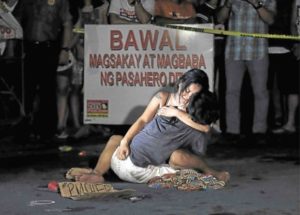
She said that she had been called a “drug addict who deserves to be beheaded, too.”
But all this has only emboldened her to push back and speak out even louder about their grief and against the killings.
“It has given me more reason to speak out and stand up because if we’re not gonna speak, if we’re just gonna let them create false claims against us, what will they think of us?” Escudero said.
“We’ll do whatever we can to be heard,” she told the Inquirer. “We are hopeful about the proceedings in the ICC. It is a huge development for those of us who have been seeking justice for almost a decade now.”
|
|
“Somehow, it has eased the weight we’ve been carrying knowing that Duterte is brought to and detained at the ICC … and that he is not here anymore,” she said.

 Ads by:
Memento Maxima Digital MarketingZ
@[email protected]
SPACE RESERVE FOR ADVERTISEMENT
.
TRIVIA:
Edgar Matobato
|
Edgar Matobato
.
|
|
|---|---|
.jpg)
Mug shot of Matobato during his October 2016 arrest
|
|
| Born |
Edgar Bernal Matobato
1959 (age 65–66) Davao City, Philippines
|
| Nationality | Filipino |
| Occupation | Former hitman |
| Years active | 1988–2013 |
| Known for | Testifying about the Davao Death Squad and Rodrigo Duterte‘s involvement |
Edgar Bernal Matobato (born 1959) is a Filipino self-confessed hitman and whistleblower who claims to be a former member of the Davao Death Squad or the “DDS”, an alleged vigilante group tasked to summarily execute suspected criminals. He gained international recognition in 2016 when he testified before the Senate of the Philippines, reporting about his experience as a hitman under the DDS. Following a non-bailable warrant for his arrest in 2017, he went into hiding with priests from the Catholic Church to ensure his safety. As of 2025, Matobato has escaped the Philippines, aided by priests of the Church, and remains in hiding following persistent death threats against him.
Early life and career
Matobato grew up in an impoverished household and is mostly illiterate.[1][2][3] He worked as security guard before joining the “Heinous Crimes Unit” in 1988. Matobato specialized in body disposal, which involved slicing corpses into smaller parts before burying them into “Laud quarry”,[1] named after a policeman who owned the quarry and its firing range,[4] or off a bridge in San Rafael, Davao City which ran over the Davao River. Matobato alleges that the Davao Death Squad told him to kill who they considered as accused criminals like drug pushers, rapists, snatchers.[5] He recounts that in 2009, he began to kill others who weren’t criminals—including businessmen, politicians, and journalists—at the command of Duterte. The alleged hit list also included former Commission on Human Rights chairwoman Leila de Lima, who had been investigating the Davao Death Squad and extrajudicial killings in Davao.[1][6]
In 2013, he withdrew from the Davao Death Squad. He then surrendered to the Commission on Human Rights in August 21, 2014, and later applied to be part of the Department of Justice‘s Witness Protection Program in September of that year. A few days before Rodrigo Duterte won the 2016 Philippine presidential election, he left the program and went into hiding.[7] Former senator Antonio Trillanes later stated that one of outgoing president Benigno Aquino III‘s last acts as president was to order that Matobato be transferred out of official custody and into the custody of a senior member of the Catholic Church.[8] A priest helped Matobato contact de Lima, a senator at the time and a critic of Duterte’s drug war, who then met up with him in early September 2016.[9]
Senate hearing
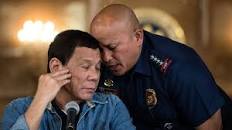
 Matobato speaking with Philippine National Police (PNP) chief Ronald dela Rosa on October 7, 2016, shortly after his arrest for illegal possession of firearms.
…
Matobato appeared before the Philippine Senate Justice Committee on September 15, 2016, during a hearing on extrajudicial killings, having been invited by De Lima who chaired the committee.[7][10] At the hearing, he narrated his experiences and even revealed names of policemen he worked with in the past. He confessed that he had killed many people, including an alleged terrorist named Sali Makdum. Matobato further recounted that Duterte, the Davao City mayor at the time, once emptied an Uzi in killing a National Bureau of Investigation official only known as “Amisola”,[a][12] though the President denied ties with Matobato and claimed not knowing him.[13]
Matobato says he was among the names listed under Davao City Hall’s Civil Security Unit (CSU) although he was considered a “ghost employee”.[14] From 1988 to 2013, Matobato said hundreds were killed in the 25-year span of his service to Davao’s CSU.[15] Senator Alan Peter Cayetano questioned Matobato, pointing out how in his testimonies, he changed his stance from “pretending to have personal knowledge” to “hearsay”.[14] Retired policeman Arturo Lascañas, who Matobato named as his handler in the DDS, was brought to the Senate in October to testify. There, he denied the existence of the DDS and allegations that he was part of it. In February 2017, Lascañas recanted his earlier statements, admitting that he had been forced to lie under oath fearing the safety of his family.[16]
Shortly after Matobato’s testimony, De Lima was removed from her position as chairwoman of the Senate Justice Committee. The House Justice Committee also began hearings on allegations that De Lima had been receiving payments from drug lords imprisoned at the New Bilibid Prison in exchange for preferential treatment.[10] The hearings led to her imprisonment and court charges filed in 2017, which were all dropped by 2024.[17]
Following the hearing, Matobato was denied Senate protection by then-Senate President Koko Pimentel.[18] Instead, his protection was facilitated by the office of Trillanes.[19] On October 7, 2016, Matobato was turned over by Trillanes to the Philippine National Police after an arrest warrant was issued against him by a Davao municipal trial court. The warrant stemmed from a failure to appear at his arraignment for a case of illegal possession of firearms, filed in 2014.[20] He was kept at Camp Crame for a week, and was later released after posting a bail of ₱30,000. Trillanes then continued providing protection for Matobato after his release.[21] He filed murder, kidnapping, and crimes against humanity charges against Duterte and other alleged DDS members in December 2016, through his lawyer, Jude Sabio.[22] He was arrested again on March 6, 2017, for a frustrated murder charge, where he posted a ₱200,000 bail. He went into hiding again in 2017, after the Panabo Regional Trial Court issued a non-bailable warrant for his arrest in connection to the kidnapping of Sali Makdum on March 27.[23]
International Criminal Court case
On April 24, 2017, representing Matobato, Sabio filed a 77-page complaint at the International Criminal Court (ICC) against Duterte and his subordinates titled “The Situation of Mass Murder in the Philippines, Rodrigo Duterte: The Mass Murderer” to its Prosecutor Fatou Bensouda. Aside from President Duterte, the complaint included Senators Richard Gordon and Alan Peter Cayetano, House Speaker Pantaleon Alvarez, Justice Secretary Vitaliano Aguirre II, Interior Secretary Ismael Sueno, PNP Chief Ronald dela Rosa, Police Colonels Edilberto Leonardo, Royina Garma, and Sanson Buenaventura, NBI Director Dante A. Gierran, and Solicitor General Jose Calida.[24]
On January 14, 2020, Sabio, accompanied by now-disbarred attorney Larry Gadon, announced that he was withdrawing his complaint at the ICC. Sabio would claim that the withdrawal was due to his refusal to be a part of the politics of Senators Trillanes and de Lima, Congressman Gary Alejano, as well as the Liberal Party against President Duterte. Bensouda responded that Sabio’s withdrawal would not affect the case, since there were 57 other communications to the ICC against Duterte.[25]
Following persistent death threats,[26] by January 2025 Matobato fled the Philippines with his wife and two stepchildren using a fake passport. Posing as a gardener, he left the country together with two Catholic priests who negotiated his escape. He was brought under the protection of the ICC,[1] and gave a deposition for the court to “secure his statements and testimonies.”[26] The Bureau of Immigration began investigating Matobato’s escape from the country, and identified the fake name he used during immigration.[27] Meanwhile, the Department of Foreign Affairs reported that Matobato did not have any passport records under his name.[28]
…