

BLOG: Ano Ba Talaga Mga POLITIKO? | Marcos’ SONA Speech cheered by corrupt politicians | “Mahiya Naman Tayo?” -PBBM | Nagsalita ang corrupt family…

MARCOS & The Congressmen Thieves


.


.


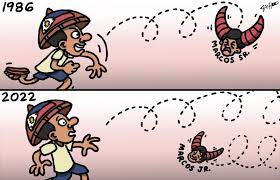

EDITORIAL – ‘Mahiya naman kayo’

One topic in President Marcos’ fourth State of the Nation Address yesterday drew a standing ovation from the 20th Congress: his condemnation of substandard and possibly non-existent or ghost flood control projects.
It was fascinating because lawmakers who earmark such projects for public funding are among the suspected beneficiaries of the questionable deals.

Also suspected to have benefited are local government and public works officials, in cahoots with private contractors. Anti-corruption advocates have said it has become increasingly common for politicians or their families to own the companies that bag flood control and other public infrastructure contracts.
Sen. Panfilo Lacson has promised to shine the spotlight on the flood control program, saying that since 2011, up to P1 trillion for flood mitigation projects could have been lost to corruption.
 |

President Marcos, in his SONA, told the crooks: “Mahiya naman kayo.” Have some shame. That was when the audience stood up and applauded. Perhaps none of those who gave the standing ovation will land on the list of people who may be implicated in flood control projects that are defective or, worse, simply imagined – “palpak, guni-guni lang,” as the President put it.
We know there are rackets in the projects, he said as he ordered the submission of a list of all the flood control projects in the past three years, along with an audit and performance review. The list of the projects will be made public for everyone’s scrutiny.
Related to this, he said he would return to Congress any General Appropriations Act for 2026 that “is not fully aligned” with the National Expenditure Program submitted by the executive. Lawmakers in fact have been criticized for diverting billions annually to the public works allocation in the GAA, with a large chunk going to flood control.
The destructive floods in recent years indicate where all those billions ended up.
In his SONA yesterday, the President vowed that those involved in anomalies including contractors would face charges.
The public will hold him to his promise.
|
|
.
Ali Baba and the 40 Thieves kids story cartoon animation
Ali Baba and the Forty Thieves
| Ali Baba and the Forty Thieves | |
|---|---|

Cassim, Ali Baba’s elder brother, in the cave by Maxfield Parrish (1909)
|
|
| Folk tale | |
| Name | Ali Baba and the Forty Thieves |
| Region | Middle East |
| Published in | The One Thousand and One Nights, translated by Antoine Galland |
“Ali Baba and the Forty Thieves” (Arabic: علي بابا والأربعون لصا) is a folk tale in Arabic added to the One Thousand and One Nights in the 18th century by its French translator Antoine Galland, who heard it from Syrian storyteller Hanna Diyab. As one of the most popular Arabian Nights tales, it has been widely retold and performed in many media across the world, especially for children (for whom the more violent aspects of the story are often removed).
In the original version, Ali Baba (Arabic: عَلِيّ بَابَا, romanized: ʿAliyy Bābā) is a poor woodcutter and an honest person who discovers the secret treasure of a thieves’ den, and enters with the magic phrase “open sesame“. The thieves try to kill Ali Baba, and his rich and greedy brother Cassim tries to steal the treasure for himself, but Ali Baba’s faithful slave-girl foils their plots. His son marries her, and Ali Baba keeps the secret of the treasure.
Textual history
The tale was added to the story collection One Thousand and One Nights by one of its European translators, Antoine Galland, who called his volumes Les Mille et Une Nuits (1704–1717). Galland was an 18th-century French Orientalist who heard it in oral form from a Syrian Maronite story-teller called Hanna Diyab, who came from Aleppo in modern-day Syria and told the story in Paris.[1] In any case, the earliest known text of the story is Galland’s French version. Richard F. Burton included it in the supplemental volumes (rather than the main collection of stories) of his translation (published as The Book of the Thousand Nights and a Night).[2]
The American Orientalist Duncan Black MacDonald discovered an Arabic-language manuscript of the story at the Bodleian Library;[3] however, this was later found to be a counterfeit.[4]
Story
Ali Baba and his older brother, Cassim (Arabic: قاسم Qāsim, sometimes spelled Kasim), are the sons of a merchant. After their father’s death, the greedy Cassim marries a wealthy woman and becomes well-to-do, living lazily on their father’s business and his wife’s wealth. Ali Baba marries a poor woman and settles into the trade of a woodcutter. Cassim and his wife resent Ali Baba and his side of the family and do not share their wealth with them.
One day, Ali Baba is at work collecting and cutting firewood in the forest, when he happens to overhear a group of forty thieves visiting their stored treasure. The treasure is in a cave, the mouth of which is sealed by a huge rock. It opens on the magic words “open sesame” and seals itself on the words “close sesame”. When the thieves are gone, Ali Baba enters the cave himself and although there is a vast amount of riches stashed inside, he modestly takes only a single bag of gold coins home.
Ali Baba and his wife borrow his sister-in-law’s scales to weigh their new wealth. Unbeknownst to them, Cassim’s wife puts a blob of wax in the scales to find out what Ali Baba is using them for, as she is curious to know what kind of grain her impoverished brother-in-law needs to measure.
To her shock, she finds a gold coin sticking to the scales and tells her husband. Under pressure from his brother, Ali Baba is forced to reveal the secret of the cave. Cassim goes to the cave, taking a donkey with him to take as much treasure as possible. He enters the cave with the magic words. However, in his excited greed over the treasure, he forgets the words to get out again and ends up trapped. The thieves find him there and kill him. When his brother does not come back, Ali Baba goes to the cave to look for him, and finds the body quartered and with each piece displayed just inside the cave’s entrance, as a warning to anyone else who might try to enter.
Ali Baba brings the corpse home where he entrusts Morgiana (Arabic: مرجانة Murjāna), a clever slave-girl from Cassim’s household, with the task of making others believe that Cassim has died a natural death. First, Morgiana purchases medicines from an apothecary, telling him that Cassim is gravely ill. Then, she finds an old tailor known as Baba Mustafa whom she pays, blindfolds, and leads to Cassim’s house. There, overnight, the tailor stitches the pieces of Cassim’s body back together. Ali Baba and his family are able to give Cassim a proper burial without anyone suspecting anything. Cassim’s wife does not find out about the cave or treasure.
The thieves, finding the body gone, realize that another person must have known their secret, so they set out to track him down. One of the thieves goes down to the town and comes across Baba Mustafa, who mentions that he has just sewn the pieces of a corpse back together. Realizing the dead man must have been the thieves’ victim, the thief asks Baba Mustafa to lead the way to the house where the deed was performed. The tailor is blindfolded again, and in this state he is able to retrace his steps and find the house.
The thief marks the door with a symbol so the other thieves can come back that night and kill everyone in the house. However, the thief has been seen by Morgiana who, loyal to her master, foils the thief’s plan by marking all the houses in the neighborhood similarly. When the 40 thieves return that night, they cannot identify the correct house, and their leader kills the unsuccessful thief in a furious rage. The next day, another thief revisits Baba Mustafa and tries again. Only this time, a chunk is chipped out of the stone step at Ali Baba’s front door. Again, Morgiana foils the plan by making similar chips in all the other doorsteps, and the second thief is killed for his failure as well. At last, the leader of the thieves goes and looks himself. This time, he memorizes every detail he can of the exterior of Ali Baba’s house.
The leader of the thieves pretends to be an oil merchant in need of Ali Baba’s hospitality, bringing with him mules loaded with 38 oil jars, one filled with oil, the other 37 hiding the other remaining thieves. Once Ali Baba is asleep, the thieves plan to kill him. Again, Morgiana discovers and foils the plan when her lamp runs out of oil and she has to get it from the merchant’s jars; the thieves give themselves away one by one hearing her approach and mistaking her for their boss. After refilling her lamp, Morgiana kills the 37 thieves in their jars by pouring boiling oil on them one by one. When their leader comes to rouse his men, he discovers they are all dead and escapes. The next morning, Morgiana tells Ali Baba about the thieves in the jars. They bury them, and Ali Baba shows his gratitude by giving Morgiana her freedom. However, she continues living with Ali Baba and his family anyway.
To exact revenge, the leader of the thieves establishes himself as a merchant, befriends Ali Baba’s son (who is now in charge of his late uncle Cassim’s business), and is invited to dinner at Ali Baba’s house. However, the thief is recognized by Morgiana, who performs a sword dance with a dagger for the diners and plunges it into the thief’s heart, when he is off his guard. Ali Baba is at first angry with Morgiana, but when he finds out the thief wanted to kill him, he is extremely grateful and rewards Morgiana by marrying her to his son. Ali Baba is then left as the only one knowing the secret of the treasure in the cave and how to access it.
Analysis
Classification
The story has been classified in the Aarne–Thompson-Uther classification system as ATU 954, “The Forty Thieves”.[5] The tale type enjoys “almost universal … diffusion”.[6]
Variants
A West African version, named The Password: Outwitting Thieves has been found.[7]
Percy Amaury Talbot located a Nigerian variant, called The Treasure House in the Bush, from Ojong Akpan of Mfamosing.[8]
An American variant was collected by Elsie Clews Parsons from Cape Verde.[9]
|
|