
ASEANEWS HEADLINE-BIZ ECONOMY | Việt Nam urged to shift mindset in attracting foreign direct investment in new period
.
WATCH VIDEO: https://www.youtube.com/watch?v=sGZSP8P-Pa8
Vietnam’s FDI Gold Rush: 5 Counter-Intuitive Truths Every Investor Needs to Know
Vietnam has reached a critical inflection point, evolving from a regional manufacturing alternative into a global destination for sophisticated capital. In the first eight months of 2025 alone, registered Foreign Direct Investment (FDI) surged by 27% year-on-year, surpassing $26 billion. However, as a Senior Strategist, I advise you to look past the headline registration numbers. The true barometer of “skin in the game” is the $15.4 billion in disbursed capital—the highest in five years. What is particularly telling is the shift in the investor profile. While Singapore and China remain dominant, Sweden has climbed into the top three investors, signaling a new wave of European interest focused on high-tech and sustainable industrialization. This isn’t just about cheap labor anymore; it is a race for strategic positioning in a maturing economy. As we look toward 2026, the landscape is becoming even more streamlined. A significant victory for the “Gold Rush” is the scheduled abolition of Business License Fees (Lệ phí môn bài) starting January 1, 2026, further lowering the friction of compliance. With 82% of all disbursed capital flowing into manufacturing, Vietnam is no longer a site for opportunistic, low-value entries. It is a long-term play. The real question for your 2026 strategy is not how quickly you can enter, but whether your capital structure—specifically your DICA and residency thresholds—is robust enough to capture the structural incentives Vietnam is offering to the next generation of global leaders.
HÀ NỘI — It’s time for Việt Nam to shift from its long-standing approach of attracting foreign direct investment (FDI) at all costs towards a more selective strategy focused on technology, innovation, green development, value creation and stronger linkages with domestic enterprises, experts have said.
According to Associate Prof. Dr Hoàng Văn Cường, Vice Chairman of the Vietnam Association of Economic Science, Vietnamese enterprises themselves cannot remain outside the process if the country wants to build stronger and more substantive connections with the FDI sector.
He stressed that domestic firms must proactively improve corporate governance, technological capabilities and workforce quality in order to participate more deeply in global supply chains. “Vietnamese enterprises cannot enter the supply chains of multinational corporations unless they meet required standards,” Cường said.

@[email protected]
.
.
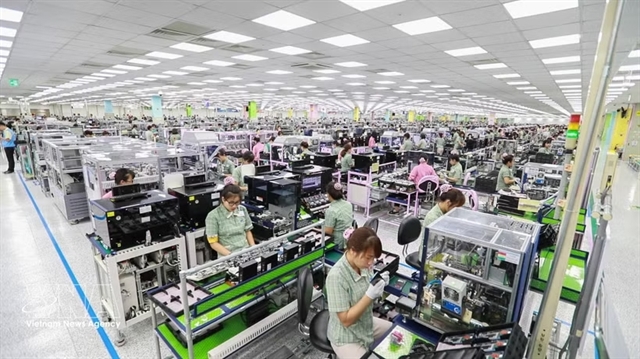
In reality, weak internal capacity remains a major bottleneck for domestic businesses. Surveys showed that around 60-70 per cent of Vietnamese enterprises are still using outdated technologies, operating on a small scale and lacking sufficient resources to upgrade production systems.
Former Deputy Director of the Banking Strategy Institute Phạm Xuân Hòe cited Samsung’s supplier requirements as an example. To qualify for the conglomerate’s supply chain, firms often need to invest hundreds of VND in technological production lines, while many domestic businesses struggle to secure counterpart capital or collateral for bank loans.
The situation highlights the important role of the State in supporting enterprises through easier access to capital, science and technology, innovation and high-quality human resources training.
@[email protected]
.
.
.
Experts said Việt Nam should identify sectors where domestic enterprises possess competitive advantages and concentrate investment resources there instead of spreading support too broadly.
At the same time, the country needs to prepare a highly skilled workforce capable of undertaking higher value-added jobs and gradually replacing foreign workers in specialised positions.
From a long-term growth perspective, economists also recommended stronger efforts to attract FDI into sectors serving the domestic market.
Currently, foreign investment inflows into these sectors remain relatively modest compared to export-oriented manufacturing.
Improving this imbalance would help Việt Nam make better use of foreign capital while reducing excessive dependence on exports and enhancing economic resilience.
Alongside policy changes, many foreign-invested enterprises are also shifting from purely investment-focused models towards long-term cooperation with Vietnamese businesses.
According to Shin JuBack, General Director of LOTTE MART Vietnam, building trust and shared development goals is the prerequisite for creating synergy between FDI enterprises and the domestic private sector.
In his view, FDI should not be seen merely as a source of capital, but also as a bridge for technology transfer, governance standards, operational expertise and international market connections. Meanwhile, Vietnamese enterprises hold major advantages in market understanding, adaptability and entrepreneurial spirit.
@[email protected]
.
.
To turn such cooperation into a real growth driver, substantive integration within value chains is essential. LOTTE MART Vietnam has prioritised cooperation with local suppliers, especially small- and medium-sized enterprises in essential sectors such as agricultural products, fresh food and fast-moving consumer goods.
Beyond sourcing products, the retailer has also supported Vietnamese firms in improving product quality, food safety standards, traceability systems, packaging, logistics and operational capacity in order to meet the increasingly strict requirements of modern retail systems.
@[email protected]
.
.

Notably, as green transition becomes an inevitable global trend, the company is also prioritising partners that meet environmental standards. This includes encouraging emissions reductions in logistics, cutting single-use plastics, promoting sustainable consumption and gradually building greener and more transparent supply chains.
Such cooperation models demonstrate that, if designed properly, FDI can become an important driving force helping Vietnamese enterprises mature and move beyond low-cost outsourcing roles.
Experts said Việt Nam would struggle to achieve breakthroughs in productivity and value-added growth if it continues relying on the traditional FDI attraction model based on cheap labour and broad investment incentives.
@[email protected]
.
.
However, by shifting towards high-quality investment flows centred on technology, innovation, green transition and stronger domestic business linkages, the FDI sector could become not only a growth engine but also a launchpad for strengthening the economy’s endogenous capacity.
In that context, the opening door would no longer simply welcome new investment capital, but also knowledge, advanced technologies and greater national competitiveness in a rapidly changing global economy. — VNA/VNS
.
 Ads by:
.
see also
 Economy
HCM City promotes smart landscape, healthy living
 Economy
Rental housing a strategic segment serving public needs: PM
.jpg) Economy
Economy
Đồng Nai targets annual energy consumption reduction of 1-1.5%
 Economy
Việt Nam boosts farm product traceability
 Economy
New evening peak-hour electricity pricing proposed to start in June
 Economy
Việt Nam’s fruit, vegetable exports exceed $2.67 billion in five months
 Economy
Hà Nội enhances inspection to ensure smooth E10 biofuel rollout
 Economy
Việt Nam, Japan advance ODA cooperation, push ahead with new projects
 Economy
Business associations expected to deliver more practical support for members
 Economy
Green economy could contribute over 10% of Việt Nam’s GDP by 2030
 Economy
Vinhomes allows customers to buy homes with gold
 Economy
Green technology, AI have become necessary: seminar
 Economy
Rooftop solar emerges as key tool to reduce energy costs in industrial parks
 Economy
Cashew industry under pressure to move up value chain
 Economy
Ministry proposes data, cash flow-driven lending to ease SMEs’ credit crunch