ASEANEWS HEADLINE-VP DU30 IMPEACHMENT 9.16.26 DAY #26 | MANILA: Fewer than 16 votes can convict VP Sara
3 EX-SC JUSTICES TELL IMPEACHMENT COURT : Fewer than 16 votes can convict VP Sara
.
.

MANILA, Philippines — Three of four retired Supreme Court justices told the Senate impeachment court on Wednesday that the two-thirds vote required to convict an impeached official should not necessarily be fixed at 16, while retired Associate Justice Adolfo Azcuna maintained that the Constitution requires the full membership of the Senate to be used in computing the threshold.
The four legal experts—retired Chief Justices Hilario Davide Jr., Artemio Panganiban, Reynato Puno and Azcuna—were invited as amici curiae, or friends of the court, as the Senate considers Senator-judge Erwin Tulfo’s challenge to an earlier ruling by presiding officer Francis “Chiz” Escudero that 16 votes, or two-thirds of the Senate’s 24 members, are required to convict Vice President Sara Duterte.
Article XI, Section 3(6) of the 1987 Constitution provides that no person shall be convicted in an impeachment case “without the concurrence of two-thirds of all the members of the Senate.”
.
.
READ: WATCH: Sara Duterte impeachment trial | Sept. 16, 2026
The dispute is whether “all the members” refers to the Senate’s full 24-member membership or only senators legally capable of exercising their functions and participating in the impeachment proceedings.
Davide, who submitted a memorandum read to the court, said senators who cannot exercise their constitutional functions should not be included in the denominator.
He identified senators who have resigned or been expelled, are physically or mentally incapacitated, are outside Philippine jurisdiction or in hiding, or are legally restrained from performing their duties.
“Nevertheless, in light of the disquisitions … we now can conclude that those who are detained, abroad, suspended or whose whereabouts are unknown cannot be included, or must be excluded, from the phrase ‘all the members of the Senate,’” Davide said.
|
|

“Clearly then, the basis of computing the two-thirds must be the number of senators who are qualified to vote, not the 24 in the present Senate.”
Davide, a delegate to the 1971 Constitutional Convention and member of the 1986 Constitutional Commission, said the framers did not specifically debate the issue but presumed that “members” meant senators capable of exercising their powers and duties.
.
Panganiban: Reality as basis
3 of 4 ex-justices: Votes to convict not fixed at 16

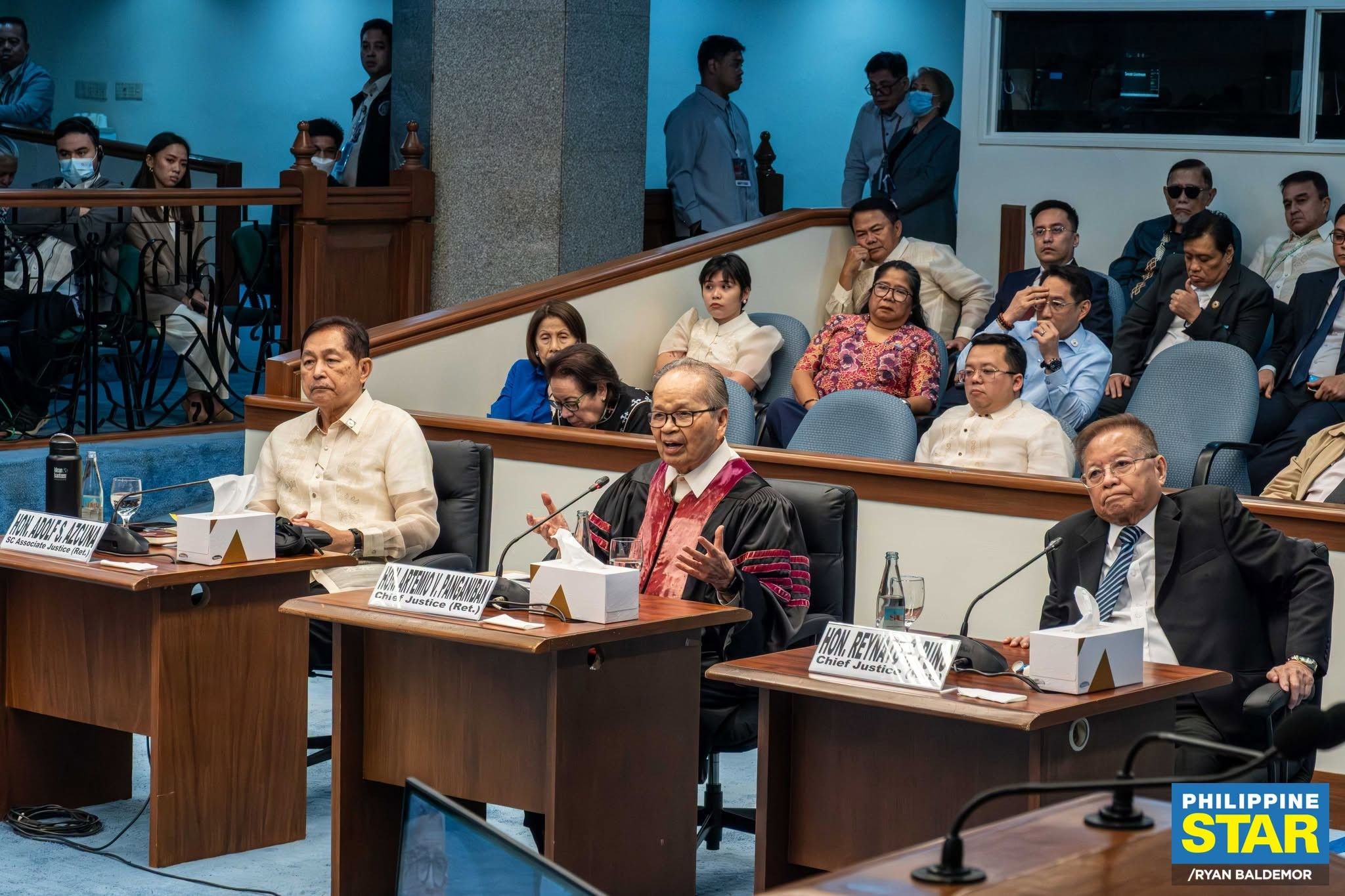
Retired Supreme Court Associate Justice Adolfo Azcuna (left) and retired Chief Justices Artemio Panganiban (center) and Reynato Puno take questions from the senator-judges at the impeachment trial of Vice President Sara Duterte on Tuesday. —Niño Jesus Orbeta
…
Panganiban acknowledged that a literal reading of the Constitution would make 16 votes necessary because two-thirds of 24 is 16. But he said constitutional interpretation cannot be reduced to “abstract mathematics.”
“Reality, sometimes, Your Honors, changes the denominator in mathematics,” said Panganiban, who is also an Inquirer columnist.
Asked by Tulfo what would happen if the Senate’s membership were reduced, Panganiban gave a hypothetical answer in which five senators died and three resigned, leaving 16.
“Yes, you have given an example why 16 should not be fixed. If for example, just an example, five … senators die, three senators resigned, that means there are only 16 left, that means that all 16 must vote unanimously? I don’t think so,” he said.
“We say why is it that we have two-thirds still, two-thirds of those able to vote … It’s because two-thirds is still two-thirds of 16. It’s two-thirds of those remaining are able to vote. Otherwise you’ll have to immobilize the Senate, as a source of justice for our people.”
Panganiban also questioned whether senators who did not attend the proceedings should be allowed to vote after failing to hear testimony, examine evidence or observe witnesses.
“Is it truthful and fair to the parties, to our country, and to our people, to allow those abroad, those looking at the pyramids along the Nile, or shopping in the fashion houses of Paris, or riding the romantic gondolas of Venice, or deliberately hiding in the dark corners of the world while everyone here, everyone here in this hall is sweating it out?” he asked.
“Meaningful adjudication requires active participation in the search for truth and fairness,” he said.
Senator-judge Joel Villanueva asked whether a detained senator remains a member of the Senate and should therefore remain part of the denominator.
Panganiban said a detained senator remains a member because the senator has neither resigned nor been expelled, but distinguished membership from the ability to exercise Senate functions.
“Does he have the right to speak? Does he know what is happening? Did he see the witnesses? Did he hear their testimony?” he asked.
Villanueva also warned against abuse of either interpretation.
“No senator should be able to manufacture a veto by disappearing, but no majority should be able to manufacture a conviction by deleting opponents from the denominator,” Villanueva said.
|
|
Panganiban replied that the Senate should ultimately consider justice for the public.
“What do our people expect from you? It’s not legalism, it’s not judicial conduct, it is justice for our people,” he said.
Puno likewise rejected a standalone literal interpretation of the two-thirds provision.
“If we give this kind of reading to Article XI Section 3(6), the threshold of 16 senators to convict will be fixed and immutable,” Puno said.
.
Puno: Note use of fraction

“If that is the intent, Article XI Section 3(6) should have simply stated that the number of votes to convict is 16 period.”
Instead, he noted, the Constitution uses a fraction.
“By using two-thirds, the number of votes to convict will have to move depending on certain factors,” he said, warning that a strict literal reading could produce “absurdities” and “injustices.”
Puno advocated a “contextual and functional” interpretation that would allow the Senate to consider whether senators who are dead, resigned, expelled, legally incapacitated or under preventive suspension should be included in the denominator.
But Puno differed from Panganiban on whether a senator’s failure to personally attend hearings necessarily prevents participation in the final vote.
|
|
He pointed to regular courts, where judges can decide cases based on transcripts even if they did not personally hear every witness.
“To determine the facts of a case, a judge need not personally see the demeanor of a witness, although that is ideal,” Puno said.
He nevertheless stressed that Duterte must be judged by an independent, fair and impartial tribunal.
Azcuna: ‘All means all’
Azcuna took the opposing position, saying the Constitution’s language should be applied according to the Senate’s full membership.
“As long as they are members of the Senate, they constitute the denominator in computing the threshold of two-thirds because all means all,” Azcuna said.
He said the threshold should not fluctuate according to attendance.
But he distinguished the denominator question from whether an absent senator may vote. A senator who missed hearings could still vote, he said, if the senator believed that after reviewing the record he or she could render an impartial judgment.
“If he or she feels that he or she can render impartial judgment, honestly, according to the Constitution and the laws… I would allow,” Azcuna said.
“I believe that this is an internal matter that should be decided by the Senate according to its own wisdom.”
The quorum question
The senator-judges also asked the amici whether the 1949 Supreme Court decision in Avelino v. Cuenco applies to the impeachment dispute.
The case involved a Senate leadership controversy and dealt with the chamber’s ability to transact business amid the absence of senators.
The amici distinguished the case from the present dispute, noting that Avelino principally concerned quorum, while the current issue concerns the affirmative vote required for conviction.
A quorum determines whether the Senate can validly transact business; it does not necessarily answer how many votes are required to convict an impeached official.
|
|
The question before the impeachment court is therefore whether an absent senator should count in the denominator for the constitutionally prescribed two-thirds vote, even if that senator cannot or does not participate in the proceedings.
A change mid-trial?
Senator-judge Francis “Kiko” Pangilinan asked whether reversing Escudero’s preliminary 16-vote ruling after the trial had begun would violate Duterte’s right to due process.
“If we reconsider the ruling and decide as a court that it is lower than 16… isn’t that a denial of the respondent’s right to due process that the rule was changed in the middle of the proceedings?” Pangilinan asked.
Panganiban said there would be no due process violation because the ruling had not been implemented through a final vote.
“There is no violation yet, because you haven’t voted yet. In other words, it has not been implemented,” he said in mixed Filipino and English.
Panganiban commended the impeachment court for consulting the amici before making a final determination.
Puno similarly said the Senate would not be changing the rule simply by reconsidering its interpretation.
“If the discussion focuses on the true meaning of that particular rule, that does not constitute changing the rule,” Puno said in Filipino.
He added that the issue was not yet ripe for Supreme Court review because the Senate had not yet voted and no concrete injury had resulted.
.
.Azcuna agreed. “The question of the interpretation of the two-thirds is a procedural matter. Procedural matters can be retroactive. There is no vested right to a procedure,” he said.
“Even if the trial has already started and you are midway through the trial and you change the interpretation of the presiding officer, I think there is no violation of due process.”
.
Aquino: Pro-acquittal if…
….
San Beda University Graduate School of Law Dean Fr. Ranhilio Aquino submitted a separate position paper arguing that the 16-vote requirement should not be treated as fixed when senators have not participated in the proceedings.
Aquino is not among the four invited amici, but the Senate impeachment court agreed to consider his memorandum and furnish copies to the senator-judges, prosecution and defense.
Aquino anchored his position on the Constitution’s grant to the Senate of the “sole power to try and decide all cases of impeachment,” read together with the Senate’s impeachment rules.
Those rules contemplate senators voting after hearing the case and participating in deliberations. Each senator is called by name and answers “guilty” or “not guilty,” with the opportunity to explain the vote.
“What is clearly presumed therefore is that the senator voting is in the session hall of the Senate and took part in the deliberations thereof,” Aquino wrote.
“There can be nothing to explain if the senator concerned was never part of the deliberations.”
He said a senator-judge should have heard witnesses, examined documentary evidence, considered arguments and participated in deliberations before voting.
Aquino warned that maintaining a fixed 16-vote threshold could allow senators who had not participated in the trial to influence its outcome.
|
|
“If sixteen (16) were a fixed number for conviction,” he wrote, absent senators could nevertheless participate in a judgment in proceedings in which they had never, or only partially, taken part.
“Every absent member would, in effect, be casting a vote of acquittal,” Aquino said.
He concluded: “The worst thing that can ever be said of any process—particularly of one partaking of the nature of a judicial process—would be to say that the result went one way rather than the way it should have gone because some of the judges were not present!”
The Senate is scheduled to hear the prosecution and defense arguments on the threshold issue on Sept. 23. Until the impeachment court acts on the challenge, Escudero’s preliminary ruling requiring 16 votes remains in effect. —With reports from Keith Clores and Isabelle Pechay
.
. .

.