
ASEAN HEADLINE-49TH ASEAN SUMMIT PHILIPPINES 2026 Day 2: | MANILA, Philippines: PH, China reaffirm vow to deepen Asean ties
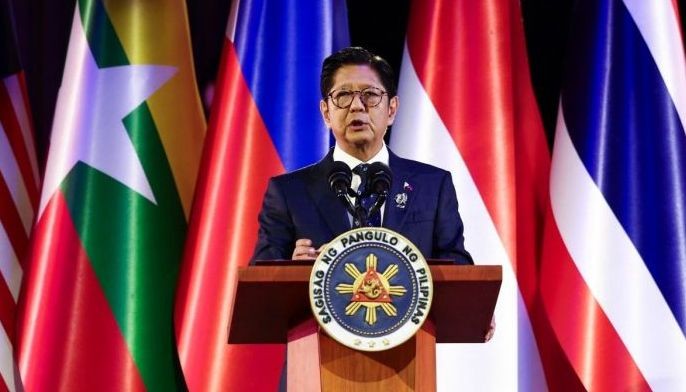
 SPIRIT OF COOPERATION President Marcos and Chinese Premier Li Qiang (sixth from left) join heads of state and representatives of Southeast Asian countries during the 29th Asean-China Summit held on Monday as part of events during the 49th Asean Summit and Related Summits hosted by Manila. —Presidential Communications Office photo

MANILA, Philippines — President Marcos and Chinese Premier Li Qiang on Monday reaffirmed their commitment to strengthening relations between the Association of Southeast Asian Nations (Asean) and China amid tensions.
Marcos and Li cochaired the 29th Asean-China Summit, part of the Philippines’ hosting of the 49th Asean Summit and Related Summits.
The meeting marked the fifth anniversary of the Asean-China Comprehensive Strategic Partnership and the 35th anniversary of Asean-China dialogue relations. Mr. Marcos said the milestones should reinforce commitments to international law.
“During this anniversary year, our shared commitment to international law and the peaceful settlement of disputes must be reflected in our actions, including through self-restraint, mutual respect, and practical cooperation,” Marcos said.
READ: China’s Li warns against unilateralism in talks with Asean leaders
 |
“Even amid regional and global uncertainties, Asean and China continue to find common ground and pursue tangible cooperation,” he added.
The President said progress had been made toward a South China Sea Code of Conduct based on international law, including the 1982 United Nations Convention on the Law of the Sea (Unclos).
Trade, investment
Li emphasized economic gains despite unilateralism, protectionism and geopolitical conflicts.
“Despite such a challenging environment, China-Asean cooperation has maintained strong momentum and scored encouraging achievements,” Li said.
READ: COC unresolved as PH turns over Asean helm
.
Trade between China and Asean exceeded $1 trillion last year, he said, while trade in the first 10 months of 2026 grew by 29.6 percent. Cumulative two-way investment surpassed $500 billion, more than half higher than five years ago.
“Although economic and trade restrictions have substantially increased around the world, we remain firmly committed to safeguarding multilateralism and promoting free trade, and endeavor to make the pie of cooperation bigger,” Li said.
|
|
Briefing reporters after the talks, Foreign Secretary Ma. Theresa Lazaro said Mr. Marcos had concluded “very important” Asean Plus One summits with China, Australia, the Republic of Korea and the United Nations.
Lazaro said the Asean-China meeting covered trade, supply chains, support for micro, small and medium enterprises, science and technology innovation, and artificial intelligence. Cooperation on transnational crime, health, cultural preservation and maritime safety was also discussed.
Code of Conduct

She highlighted Li’s commitment to an early agreement on the maritime code.
“One of the important statements of the Chinese premier was when he said that he is committed towards an effective, substantive and early conclusion of the Code of Conduct, which is consistent with the 1982 Unclos,” Lazaro said.
The proposed code is intended to guide conduct in the disputed waterway and help prevent incidents from escalating. It is not designed to settle territorial and maritime claims.
Negotiations have advanced, but key differences remain. Lazaro said on Sunday that parties had reached provisional agreement on about 80 percent of the draft’s paragraphs, up from roughly 50 percent when the Philippines assumed the Asean chairship early this year.
|
|
“Definitely, there’s no conclusion yet,” Lazaro said, confirming that the code would not be finalized and signed before Manila hands over the chairship to Singapore in 2027.
Unresolved issues include the code’s geographic scope, definitions of key terms and whether it should be legally binding. Its scope will determine where provisions apply, while its legal status will affect implementation.
.
Remaining differences

Lazaro said some Asean members were concerned that a legally binding instrument could require domestic ratification. “Some have their sensitivities, like if you say that the document is legally binding, there is also a ratification process on the part of certain Asean member states,” she said.
She said another five to six months might have been enough to complete negotiations, but the Philippines would not secure a final agreement during its chairship. She recognized Malaysia and China, the code’s cochairs, for guiding the process.
Negotiators have also reached a provisional understanding on the relationship between the code and the 2002 Declaration on the Conduct of Parties in the South China Sea, a nonbinding framework. The COC is envisioned as a guide for conduct and a platform for voluntary maritime cooperation under Unclos.
Lazaro said the summit produced four outcome documents, including a joint statement marking the fifth anniversary of the Asean-China Comprehensive Strategic Partnership, approved by all Asean member states.
|
|
China is the Philippines’ top source of imports, making stable trade important for everyday goods and materials and equipment used by local businesses. Cooperation against online scams could also help protect Filipinos from fraud, including schemes using fake job offers. —With a report from Kathleen De Villa
 Ads by: