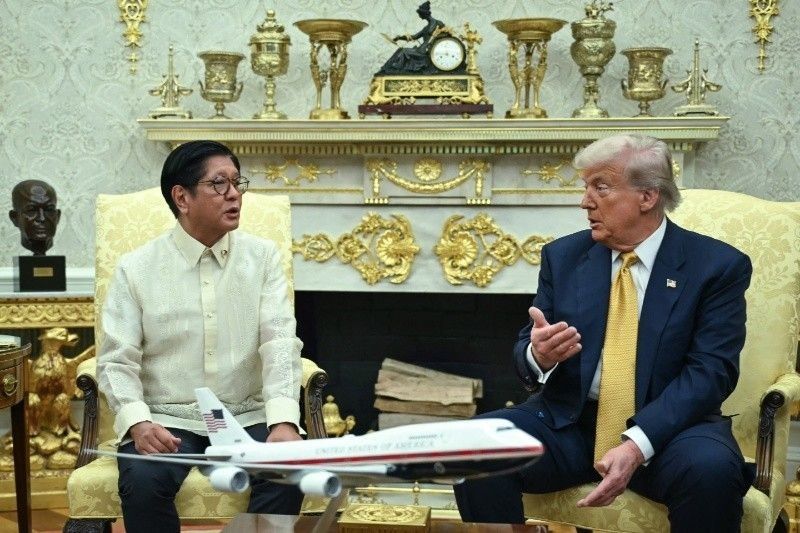
ASEANEWS HEADLINE-US PHIL TRADE | MANILA: Marcos gets US tariff cut by 1%
FULL MEETING: President Trump Holds Bilateral Meeting With Philippine President Marcos Jr. | AC1G
Marcos calls Trump’s 1% tariff cut on PH a ‘significant achievement’ | ANC
.
US exports get zero tariff
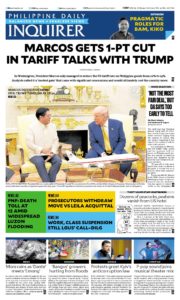
MANILA, Philippines — After a series of negotiations capped by President Marcos’ official visit to the United States, the Trump administration has agreed to cut by one percentage point its 20 percent tariff being readied for Philippine exports to the US, in a deal that will also remove the import duties on American automobiles and increase Philippine purchases of certain US goods.
The 19 percent duty to be levied on Philippine exports starting August is still higher than the initial 17 percent announced by US President Donald Trump when he launched what he called the “Liberation Day” tariffs in April.
The new rate is nevertheless the second-lowest in the region, higher only than the 10 percent slapped on Singapore, which has a bilateral free trade agreement with the US.
“We concluded our trade deal, whereby the Philippines is going open market with the United States, and zero tariffs. The Philippines will pay a 19 percent tariff,” Trump posted on Truth Social after his bilateral meeting with Marcos last Tuesday. Marcos described the revised rate as a “significant achievement.”
“Now, one percent might seem like a very small concession. However, when you put it into – in real terms, it is a significant achievement,” the President told reporters in Washington before departing for Manila.
“There is more to be spoken about with the United States concerning that the tariff rates and our trade deals,” he added.
Marcos explained that under the deal, the Philippines will scrap the tariffs on automobile imports from the US.
“Because we have a tariff on American automobiles, we will open that market and no longer charge tariffs on that,” he said.

The Philippines will also raise US imports of soy products, wheat and pharmaceuticals, a setup that – according to Marcos – would lower the prices of medicines in the country.
Impact downplayed
Malacañang claimed that the tariff would not have much impact on the Philippine economy because it is not dependent on exports to the US.
Presidential Communications Undersecretary Claire Castro said only 16 percent of Philippines exports are sent to the US, 67 percent of which are levied with low or zero tariffs under global trade agreements.
“Because of this, the country will intensify efforts to make Philippine exports more competitive. Based on records, the Philippines is not US export-dependent. In short, there is an effect, but its impact is not huge,” Castro said at a press briefing in Manila yesterday.
When asked about the fact that the adjusted tariff on Philippine exports is higher than the original rate of 17 percent, Marcos replied: “Well, that’s how negotiations go.”
“We came here, when we arrived in Washington, tariff rates were 20 (percent). So, why it came up from 17 to 20 is an internal matter with the United States government… So, we tried very hard to see what we can do. And we managed the one (percentage point) decrease in tariff rates,” he added.
Before Marcos’ visit to Washington, Special Assistant to the President for Investment and Economic Affairs Frederick Go said the Philippines would negotiate a bilateral comprehensive economic agreement or a free trade deal with the US.
In a recent letter informing Marcos about the tariff policy, Trump claimed that the relationship between the Philippines and the US has been “far from reciprocal.” According to Trump, the Philippines’ tariff and non-tariff policies and trade barriers have engendered “long-term and very persistent trade deficits.”
The US posted a $4.9 billion trade goods deficit with the Philippines last year. Marcos said the Philippines would offset the trade deficit by increasing imports from the US.
“That’s part of the new regime that we will be following in terms of trade with the United States,” the President said.
Trump, meanwhile, praised Marcos’ way of handling the talks, calling him a “very good and tough negotiator.”
“We respect their leader greatly… He is very tough for negotiating, but that’s okay,” the US leader said.
‘Principled, pragmatic’
Speaker Martin Romualdez said the development was proof of the administration’s “principled and pragmatic” foreign policy.
“This is more than just an official working visit. This is a statement of confidence: that the Philippines is ready to lead, to compete and to stand tall among nations,” Romualdez said.
“President Marcos has once again proven that our foreign policy can be both principled and pragmatic, firm in defending our interests, but also generous in building alliances that uplift our people,” he said. “Access to the US market is a game-changer,” he stressed.
Other administration lawmakers also lauded the outcome of Marcos’ recent diplomatic engagement with Trump.
“President Marcos Jr.’s engagement with President Trump exemplifies his skillful leadership in advancing the Philippines’ interests on the global stage. His independent foreign policy ensures our nation’s priorities remain at the forefront,” said Rep. Paolo Ortega (La Union).
Rep. Zia Alonto Adiong (Lanao del Sur) also praised Marcos and vowed to “stand firmly” behind his “principled leadership.”
“His ability to maintain strong alliances while prioritizing our sovereignty is a testament to his vision for a stronger Philippines,” Adiong said.
“We agree with President Trump’s observation that an overreliance on any single power would not serve our nation’s interests. President Marcos Jr.’s independent stance ensures we avoid such pitfalls while building robust global ties,” Rep. Jay Khonghun of Zambales said.
“President Trump’s respect for President Marcos Jr. reflects the global recognition of his leadership. We are proud of his commitment to safeguarding our sovereignty and advancing our national interests.” Rep. Lordan Suan (Cagayan de Oro) said. Sen. Vicente Sotto III called the president’s official visit to the US “fruitful and productive.”
Worst insult, unfair deal
 ANGRY
ANGRY
But some lawmakers and others groups have expressed alarm over President Marcos agreeing to zero tariff on US exports and a measly one point cut in US tariffs on Philippine products.
Sen. Panfilo Lacson called it “not the most fair deal between decades-old friends or allies like the US and the Philippines.”
“That proposal is the worst insult that a host can throw at his guest. Maybe it is time for us to look for other trade partners,” he added.
Sen. Imee Marcos said that while she has not seen yet the details of the agreement, it’s clear even to non-experts that a 19 percent tariff on Philippine product and zero rate on the US cannot be considered a fair deal.
“That seems highly imbalanced,” Sen. Juan Miguel Zubiri said of the trade agreement.
Sen. Francis Pangilinan said the trade deal with US President Trump will have long-term adverse impact on agricultural production and ultimately on the livelihoods of farmers and fisherfolk.
“While we understand the need for economic stability, it should not come at the price of the livelihoods of our agricultural workers. If implemented without careful consideration, a zero tariff policy will disadvantage our farmers and fisherfolk, and put in peril our work toward food security and national development,” Pangilinan said.
“New policies and agreements must come with clear safeguards for local livelihoods. Our farmers need support, not setbacks. They need us to protect them, rather than put their livelihoods at risk,” the senator added.
For Sen. JV Ejercito, President Marcos’ trade deal with US President Trump is “lopsided” and “grossly advantageous” to the Philippines.
“It’s so unfair. I thought the Americans treat as ‘little brown brothers, then why do we always end up at the raw end of the deal,” Ejercito told reporters in Filipino yesterday.
The militant Bagong Alyansang Makabayan said the deal between Marcos and Trump was a sellout of the country’s sovereignty and economic interests.
“It is embarrassing to hear Marcos talk about independent foreign policy and self-reliance while repeatedly mentioning that the US will assist the Philippines in modernizing the country’s defenses and protecting our sovereignty,” Bayan president Renato Reyes said in a statement.
The Alliance of Concerned Teachers (ACT) belittled Marcos’ success in making Trump agree to lower tariff of 19 percent on Philippine exports.
“This is a lopsided and humiliating agreement, signed while the country is being battered by the effects of Typhoon Crising and the southwest monsoon with millions affected and classrooms submerged,” ACT said.
“The agreement commits the country to a regime of zero tariffs on US goods, opening the floodgates to a new wave of agricultural dumping, foreign retail invasion, and domestic industry displacement,” ACT added.
It warned that deal will only worsen job insecurity, erode local livelihoods further, and drain public revenues best spent for rebuilding schools, improving salaries, and supporting communities in crisis.
“The timing of this agreement is damning. With the country reeling from natural calamity, the government abandons its own people to secure a deal dictated by Washington,” ACT said. “We can expect billions to be pledged for foreign military cooperation and trade facilitation as classrooms remain flooded, thousands of students displaced, and teachers expected to serve as relief workers and unpaid crisis responders,” it added. – Delon Porcalla, Neil Jayson Servallos, Emmanuel Tupas, Bella Cariaso
.

 Memento Maxima Digital MarketingANGRY