
LIFE+STYLE-FOOD | Manila struggles to keep a lasting hawker culture, casts eyes on how Asian nations lifted street food
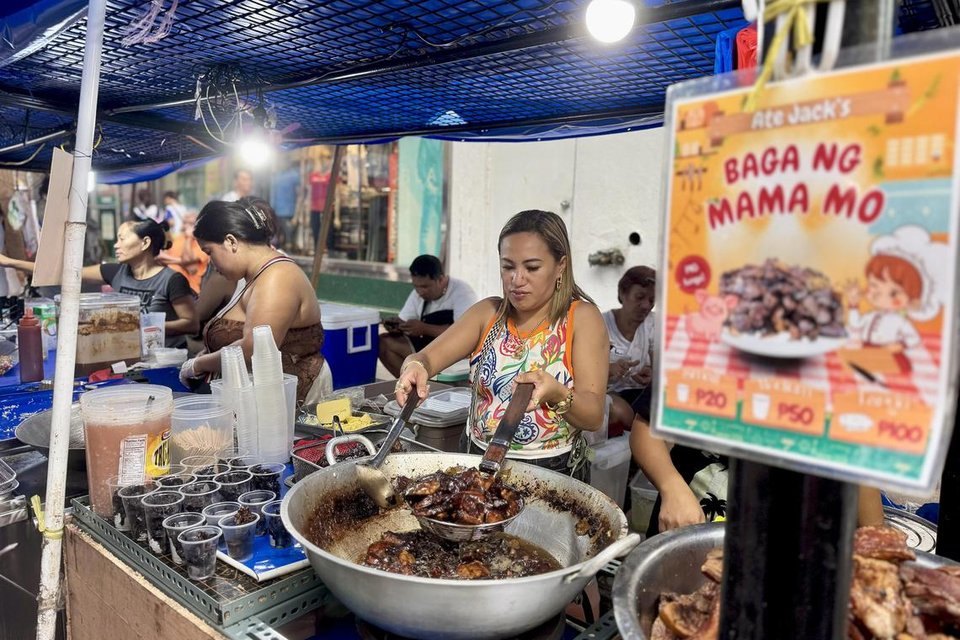
Ms Jacklyn Alfaro cooking a fresh batch of fried pork lungs, the delicacy that made her stall famous in Carriedo Street in Manila, on July 31./ ST PHOTO: MARA CEPEDA
Summary
- Manila’s street vendors face displacement due to street clearing operations, unlike other South-east Asian cities that integrate them into local culture.
- Cultural perception in the Philippines associates street food with poverty and poor sanitation, hindering its development into a recognised culinary heritage.
- Urban planning and political will are lacking, with few resources allocated to creating regulated spaces for vendors, leaving them in legal limbo.

MANILA – One humid July morning in the heart of Quiapo district in the Philippine capital, street vendor Jacklyn Alfaro dropped strips of pork lungs into a vat of sputtering oil.
The sharp, savoury aroma drifted into the air, mingling with the exhaust of jeepneys and the chatter from a long line of customers waiting for her speciality. She scooped out the crackling, browned pieces and laid them neatly on a tray, ready for the mid-afternoon rush.
Her stall now sits just a few paces from her original spot in Manila’s famed Carriedo Street – once a bustling stretch packed with vendors selling everything from snacks to phone cases. That changed when Mayor Francisco Moreno’s street clean-up policy, which kicked off on June 30, cleared the city’s main roads to make way for pedestrians and cars.
 Memento Maxima Digital Marketing
For now, Ms Alfaro has moved to this vending zone that is approved by the authorities, but she longs to return to Carriedo’s heavy foot traffic.
Her story is part of a broader wave of clearing operations sweeping through Manila, where the drive to reclaim pavements has pushed vendors into side streets and stirred debate over their place in the urban landscape.
While other South-east Asian capitals have turned street vendors into tourist draws and pillars of local food culture, the Philippines has never built the infrastructure, policies or public attitudes needed for such a system to thrive in most urban centres. Instead, vendors here remain in a constant cycle of displacement and return, tolerated but rarely integrated.
Mr Moreno’s directive bans vendors from major roads and sends city hall teams to dismantle stalls blocking the pavements. Supporters say it is about restoring order and mobility in a city where footpaths often double as makeshift markets. Critics argue that the directive is car-centric and economically damaging, and has pushed vendors to low-traffic side streets, where their sales have collapsed.
Top stories
Swipe. Select. Stay informed.
…
![CMG20250221-PekYL01白艳琳/郑智浩/经营照片:主文:speeding offences/副文:Motorcyclists and pillion riders [along Yishun Ave 2] Generics of fixed speed camera along the road on Feb 21, 2025.](https://cassette.sphdigital.com.sg/image/straitstimes/f437986fc3ccb696fbaa76cf623e7aa7a101f09ba606d9afb4318087ef5175de?w=480)
Singapore
Over 118,000 speeding violations in first half of 2025; situation shows no signs of improvement: TP

Singapore
Four men arrested in Bukit Timah believed to be linked to housebreaking syndicates

Singapore
Criminal trial of Hyflux founder Olivia Lum and five others starts Aug 11

Singapore
Profile of Kpod user has shifted from hardcore drug users to young people: Experts

Tech
Former data analyst creates AI tutor that assesses students based on Singapore schools’ criteria

Opinion
I used to be impatient. Then I became a granddad

Singapore
Minor Issues: Parents, is it worth dying for a pay cheque?

Life
‘Best birthday gift’: Actress Michelle Chia marries 41-year-old boyfriend before 50th birthday
“I used to earn up to 4,000 pesos (S$90) a day,” said 31-year-old vendor Ricardo Ibanez, who for years sold balut, or fertilised duck eggs, outside a busy wet market in one of Manila’s main roads. Under the city’s new vendor policy, he was pushed into a nearby side street, where he now considers it a good day if he makes 1,000 pesos.
Mr Ibanez has resisted proposals for a fixed hawker zone, saying the freedom to move allows him to follow the crowd. “I earn better if I can sell wherever I please,” he said.
Street food for survival, not heritage
The deeper reason for the Philippines’ absence of a hawker tradition lies in cultural perception, said Mr Jayson Maulit, executive chef and managing partner of the restaurant Trining’s Kitchen Stories.
“Filipinos have this perception that street food is dirty,” he said, noting how financially struggling families often turn to selling snacks on the street as a last resort. This link to survival, rather than to craft or culinary heritage, has kept street food associated with poverty and poor sanitation, said Mr Maulit.
Fast-food chains – offering consistency, branding and air-conditioned comfort – have further shaped Filipino dining habits, crowding out informal food vendors from the mainstream.
Unlike Thailand, where street cooking is a celebrated art, or Singapore, where hawker fare has earned Michelin stars, the Philippines has no national body to set standards or reward excellence in street food.
Street vending is still viewed by Filipinos as a temporary fallback, in what Mr Maulit described as “the lifeline in a crisis”, rather than a legitimate, skilled profession. Without that cultural legitimacy, vendors remain excluded from long-term urban planning and economic policy.

Though street food is accessible and cheap, some Filipinos still view it as “dirty”, says an executive chef.
ST PHOTO: MARA CEPEDA
Policy and planning gaps
Filipino landscape architect and urban planner Paulo Alcazaren said Manila’s predicament is not inevitable, but the product of decades of piecemeal policy, chronic urban-planning problems and weak execution.
While Asian cities share a history of street vending, Mr Alcazaren noted that places like Singapore and Hong Kong treat it as a permanent feature of the urban economy, building hawker centres and night markets with proper utilities and sanitation systems. Manila, by contrast, has relied on periodic clearing operations without the infrastructure to integrate vendors.
Mr Alcazaren, who worked on the pedestrianisation of Singapore’s Orchard Road, said the city-state’s hawker system was the product of years of deliberate planning.
Street food sellers were moved into purpose-built centres near transport hubs and markets, each with water, power, waste disposal and seating. The Government regulated hygiene, issued licences and maintained the facilities – turning what was once seen as a messy necessity into a source of civic pride and tourism revenue.
“In Manila, what I would see as a problem is that although there would be seasonal clearing of the streets, alternatives were not provided (for vendors),” Mr Alcazaren said.

“No vendors allowed” posters have been put up in key streets in Manila as part of the clean-up efforts in the Philippine capital.
ST PHOTO: MARA CEPEDA
Some Philippine cities have shown it can be done. Nearby urban centres like Pasig and Quezon City have designated vending spots in pedestrian corridors and transport terminals, rolling out a system that includes standardised food carts and stalls, sanitation and safety checks.
But the number of vendors in these cities is nowhere near Manila’s, making such schemes easier to manage. These localised models have given vendors stability while keeping public spaces passable, but they remain the exception rather than the norm.
“There have been sporadic attempts to regulate vending in the last few decades, but most of the city hall plantillas (staff) are filled with engineers who know how to build roads and bridges… Fewer areas have anyone who has any background in urban design or landscape architecture,” Mr Alcazaren said.
Without the political will to retrofit spaces or invest in purpose-built facilities, vendors remain in legal limbo.
One-street solution?
One idea floated in Manila’s long-running debate is to designate a single street as a permanent food bazaar, where hawkers can operate legally under a unified system of regulation, sanitation and order.
Similar set-ups work in Bangkok’s night markets and Singapore’s hawker centres, where vendors benefit from built-in infrastructure, while visitors know exactly where to find them.
Mr Moreno said the city has looked into such schemes but believes Manila’s scale makes them difficult to implement.
The capital has some 50,000 registered vendors – a number that does not include the “snipers”, or unlicensed sellers who set up briefly to avoid arrest. Concentrating them into one area, he argued, would be unmanageable without constant enforcement, adequate space and sustained political will.

City hall officials from Manila’s Hawkers Department going around crowded streets to ensure vendors are not blocking the path for pedestrians and vehicles.
ST PHOTO: MARA CEPEDA
Vendors like Ms Alfaro still hope for something similar. She envisions Carriedo – with its steady pedestrian traffic and historic charm – transformed into a clean, organised food street, rather than emptied out entirely.
“We really envy what they’ve done in Thailand, Taiwan, Singapore and Hong Kong, where they have proper food bazaars. Why can’t we do the same in Manila? We hope we can replicate that here some day,” she said.


@[email protected]
Mara Cepeda is Philippines correspondent at The Straits Times.
AI generated