ASEANEWS HEADLINE-MYANMAR MARTIAL LAW | ‘I do not know if she is still alive’: Son of Aung Sun Suu Kyi makes plea for her release
Myanmar: Protesters burn ASEAN flag as Suu kyi’s trials to begin
..


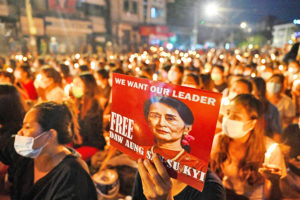
FREE ASEAN
FREE MYANMAR/CAMBODIA/THAILAND /LAOS
FREE Aung San Suu Kyi
.
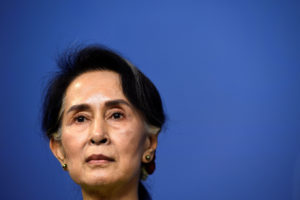 BANGKOK – More than two weeks after the Myanmar junta announced it had placed its best known political prisoner Aung San Suu Kyi under house arrest, questions remain over her whereabouts.
The junta announced on April 30 that it had placed Ms Suu Kyi, 80, under house arrest where she will serve out her remaining sentence of about 18 years.
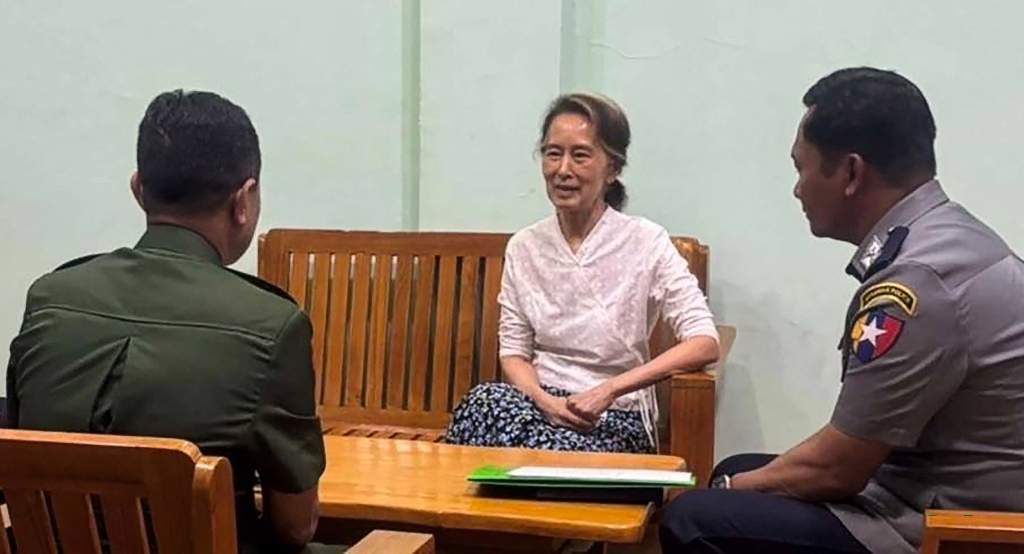
The Myanmar state media had then shown one picture of her seated on a wooden bench speaking to two uniformed officers. But many observers have questioned the authenticity of the photograph and when it was taken.
Since then, no one has been able to independently meet or speak with her.
This again prompted her son Kim Aris, 48, to ask for access to his mother.
“I still have no verified information about her condition or whereabouts. I do not know if she is still alive,” Mr Aris posted on his Facebook page on May 9.
He had also spoken to The Straits Times on May 7, reiterating concerns about his mother’s health. It was previously reported that she had bone and gum issues, a heart condition and low blood pressure.
 |
.
Top stories
Explore top stories from all sections in one place

Singapore
In GE2025’s closest contested wards, the ground game continues a year on

Singapore
Site supervisor dies after bricks, canopy collapse on him at house near Upper Paya Lebar

Singapore
At least one MCST forced-sale bid a month over unpaid condo fees in past year

Singapore
Singapore doctor sees patients in the world’s fiercest war zones, like Gaza and Sudan

Asia
Train driver charged over fatal collision with bus in Bangkok

Asia
Japan’s bullied children have found a new controversial avenue to get back at their tormentors

Opinion
A man fell unconscious at a coffee shop. Life went on
|
|
.
Mr Aris last heard from his mother in a handwritten letter two years ago. He desperately wants to see “proof of life”, which became a hashtag on social media as many started sharing that phrase together with Ms Suu Kyi’s portrait.
Others also said they were not certain whether the former Myanmar leader has been placed under house arrest.
Former US ambassador to Myanmar Scot Marciel said this seems likely but is not certain.
“(The Myanmar regime) presumably would make such a move to show ‘flexibility’ to external powers, but in reality, such a move would mean very little, other than possibly greater comfort for her,” he said.
The civilian-formed National Unity Government (NUG) views the junta’s announcement with scepticism.
“The junta wants the diplomatic benefit of saying ‘house arrest’ without giving anyone proof of her condition, location, or freedom of contact,” the NUG’s foreign minister Zin Mar Aung told ST.
“What we are witnessing is a form of hostage diplomacy,” she added, with the junta using Ms Suu Kyi as a bargaining chip with ASEAN and others.
|
|
.
.
Calculated move by the regime
Ms Suu Kyi was detained after the military staged a coup and overthrew her civilian government on Feb 1 2021, alleging electoral fraud in the 2020 polls in which her National League for Democracy party won a landslide victory.
Mr Amara Thiha, a non-resident fellow at the Stimson Center, a US think-tank, believes the regime wants to signal a step towards gradual normalisation by moving Ms Suu Kyi to house detention.
“This may serve to encourage continued economic engagement and investment commitments from key partners,” he said.
|
|
.
Aung San Suu Kyi’s son urges Myanmar govt to provide ‘proof of life’
|
|
.
Ms Zin Mar Aung said: “The junta appears eager to manufacture symbolic gestures and controlled political optics to ease international pressure, regain diplomatic space, and encourage gradual re-engagement from regional and international actors.”
But others feel that visiting diplomats, especially those from a superpower like China, may have had some influence over the Myanmar regime’s treatment of Ms Suu Kyi.
China’s Foreign Minister Wang Yi visited Myanmar on April 25, as part of a visit to Indochina countries that included Cambodia and Thailand.
“Chinese pressure could certainly be related,” said Dr Hunter Marston, director of the South-east Asia programme at the Lowy Institute. “It was not in the regime’s interest for Daw Suu to die in prison on their watch. Releasing her bolsters Beijing’s rationale to rehabilitate Naypyitaw in the international community.”
With untapped investment opportunities and mega projects in infrastructure and energy in Myanmar, it is also in China’s interest to see political stability return.
“Therefore (China) would like to see Naypyitaw’s reintegration into the international community, and one surefire way to see that eventuality materialise is to have Daw Suu released safely. So it would naturally be lobbying the junta to free her,” said Dr Marston.
|
|
.
ASEAN mulls over reopening door to Myanmar
After five years of banning Myanmar’s military chief from attending the ASEAN leaders’ summits following the 2021 coup, the regional grouping is beginning to shift its stance.
The Philippines, which is the 2026 ASEAN chair, issued a statement on May 6 urging Myanmar to show greater commitment to fostering national reconciliation by providing increased transparency surrounding Ms Suu Kyi’s whereabouts. It also asked that the ASEAN special envoy on Myanmar, currently Philippine Foreign Secretary Theresa Lazaro, be given access to her.
|
|
.
Legal team plans to meet Myanmar’s detained ex-leader Suu Kyi this weekend
|
|
.
Mr Marciel, the former US envoy to Myanmar, believes it is reasonable for the ASEAN special envoy to want to meet Ms Suu Kyi.
“The risk is that some in ASEAN would proclaim such a meeting as a positive step, adding to the momentum to bring Myanmar back into the ASEAN fold, when in fact the military has done nothing substantively to meet ASEAN’s own Five-Point Consensus,” he said.
The Five-Point Consensus includes targets like having an immediate cessation to violence and holding constructive dialogue among all parties concerned to find peaceful solutions. Till today, barely any of the points have been reached.
With the ongoing civil war across the country, the analysts ST spoke to are not convinced the Myanmar regime will accede to ASEAN’s request to meet Ms Suu Kyi.
They believe that the junta sees no real benefit for it to allow access to her and may instead use the opportunity to extract demands out of the grouping.
“It is reasonable to expect that any access granted would be conditioned upon certain assurances,” said Mr Amara Thiha.
NUG’s Zin Mar Aung said these assurances could include the junta demanding ASEAN’s recognition of its new administration, gradually inviting former military chief Min Aung Hlaing, now the President, back to summits and having ASEAN pressure the resistance forces to cease their activities.
Dr Marston believes that access to Ms Suu Kyi may enable the outside world to determine her well-being and get her opinions about the current situation.
But the meeting may not yield much as she has not been clued into the developments across the country while behind bars under a media blackout, he added.
|
|
.
“As such, ASEAN should expend its energies elsewhere, such as using what little leverage it has over the generals to compel them to undertake further reforms before it grants them legitimising measures such as invitations to future gatherings,” Dr Marston said.
Some believe that Naypyitaw has the upper hand as ASEAN seems to have run out of ideas.
“The junta knows that ASEAN’s inability to resolve the crisis in Myanmar and the lack of full representation within the body as a result is a stain on the bloc’s record, and that all parties would like to see the reintegration of Myanmar within ASEAN eventually. So it is content to play for time and let the embarrassment fester,” said Dr Marston.
“Min Aung Hlaing knows that ASEAN needs Myanmar to be a cohesive regional organisation more than he needs ASEAN to legitimise his own regime,” he added.
For Mr Aris, the anxiety over the welfare of his mother eclipses political deliberations.
Ms Suu Kyi had spent 15 years, over the period of 1989 to 2010, under her first house arrest meted out by a previous junta. She is into her sixth year of her second round of incarceration.
“As a son, my hope remains very simple – I want to see my mother released, to know that she is safe.”
.