
ASEANEWS HEADLINE | ASEAN risks irrelevance as sub-groupings grow, Sec-Gen Kao warns
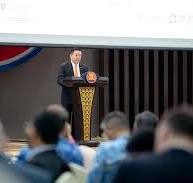
ASEAN Secretary-General Kao Kim Hourn speaks at the ASEAN Think Tanks Summit at the grouping’s headquarters in Jakarta./ PHOTO: COURTESY OF SINGAPORE INSTITUTE OF INTERNATIONAL AFFAIRS

JAKARTA – ASEAN risks being sidelined as countries increasingly turn to smaller groupings to deal with security and other challenges, its Secretary-General Kao Kim Hourn warned on Sept 14.
With new alliances and partnerships proliferating across the Indo-Pacific, ASEAN must ensure that the regional institutions it has built over decades remain relevant and are able to bring countries together, he said.
“For ASEAN, the question is how to ensure that this increasingly complex regional architecture does not become so fragmented that ASEAN-led processes lose their coherence, relevance or convening power,” Kao said.
The issue will take on added significance in 2027, when Singapore takes over as ASEAN chair from the Philippines as the grouping marks its 60th anniversary.
Kao said the milestone should be an opportunity not just to celebrate six decades of regional cooperation, but also to ask whether ASEAN’s institutions and ways of working are still suited to a much-changed world.
“The test of its centrality will lie in what its institutions can achieve,” he said. “Centrality, after all, cannot rest on institutional inheritance alone.”
He was speaking to more than 150 diplomats, policymakers, academics and think-tank researchers at the opening of the third ASEAN Think Tanks Summit at the grouping’s headquarters in Jakarta.
.
 Ads by:
Memento Maxima Digital Marketing
@[email protected]
SPACE RESERVE FOR ADVERTISEMENT
.
.
Top stories
Explore top stories from all sections in one place

Singapore
Air quality across Singapore in unhealthy range for the first time since 2019

Singapore
PSD reviewing paper that alleges civil servants disproportionately bought homes near unannounced MRT stations

Opinion
Why it would be folly to discount the US’ ‘bipolar’ military

Asia
Rough weather hinders third-day search for 129 missing after ferry capsizes in Indonesia

World
Are we losing control of AI? What’s driving new fears

World
Nvidia CEO Jensen Huang puts Trump on speakerphone while downplaying AI risks

Life
Television’s A-listers glitter on Emmys red carpet
The two-day summit was organised by the Singapore Institute of International Affairs on behalf of the ASEAN Institutes of Strategic and International Studies, a network of think-tanks from across the region.
Ads by:
Memento Maxima Digital Marketing
@[email protected]
SPACE RESERVE FOR ADVERTISEMENT
.
.
.
Rising proliferation of sub-regional groupings
Kao’s remarks come as the security landscape around South-east Asia becomes increasingly complex, with countries turning to smaller groupings and partnerships alongside long-established ASEAN-led forums.
The shifting strategic landscape has seen the emergence of new arrangements involving countries in and around South-east Asia.
These include a trilateral partnership between the US, Japan and the Philippines, whose leaders held their first summit in 2024, and growing four-way cooperation between the US, Japan, Australia and the Philippines, sometimes referred to as the Squad.
Such groupings are not necessarily intended to replace ASEAN, but their proliferation has caused some to raise questions over whether ASEAN-led forums could lose influence, as countries increasingly turn to smaller arrangements to address specific challenges.
Kao did not name any such groupings, but he said that ASEAN should make better use of the institutions it already has, including the East Asia Summit, ASEAN Regional Forum and ASEAN Defence Ministers’ Meeting-Plus, which bring the grouping together with major powers, including China and the US.
“The issue, therefore, is not whether dialogue remains relevant, but how ASEAN can make more strategic and effective use of the instruments and mechanisms already at its disposal,” he said.
Dialogue and diplomacy should remain ASEAN’s “instruments of first resort”, particularly as competition between major powers intensifies, he added.
But ASEAN’s continued relevance would ultimately depend on what these institutions could deliver, Kao said. Its longstanding ambition to remain at the centre of regional diplomacy – often referred to as ASEAN centrality – could not simply be taken for granted.
“It must be earned continually through ASEAN’s ability to bring countries together, manage differences and enable collective action,” he said.
Economic, tech and security challenges
Kao also highlighted economic resilience, technological change and transnational security as major challenges for ASEAN as it enters its seventh decade.
He said energy, food and economic security could no longer be treated separately, as disruption in one area could quickly spill over into others.
But ASEAN should not respond to greater uncertainty by retreating from the openness and economic integration that have helped drive the region’s growth.
“The task is therefore not to reduce interdependence, but to make it safer – through diversification, redundancy, stronger regional capacity and a greater ability to absorb and recover from shocks,” Kao said.
On artificial intelligence and other emerging technologies, Kao said ASEAN had to ensure that the benefits were widely shared, rather than allowing technological change to deepen existing inequalities.
He added that the grouping also faces an increasingly interconnected range of threats, from maritime tensions and cyberattacks to online scams, transnational crime and climate-related disasters.
As ASEAN prepares to mark six decades since its founding in 1967, Kao said it should examine whether institutions and approaches that served it in the past remain suited to a very different strategic environment.
“ASEAN has never advanced by standing still. It has advanced by adapting – by thinking together, making choices together and finding ways to move forward together,” he said.
Ads by:
Memento Maxima Digital Marketing
@[email protected]
SPACE RESERVE FOR ADVERTISEMENT
.
.
Hariz Baharudin is Indonesia correspondent at The Straits Times. He has an interest in Indonesia and the wider currents shaping South-east Asia.
Ads by:
Memento Maxima Digital Marketing
@[email protected]
SPACE RESERVE FOR ADVERTISEMENT
.
.
ASEAN, with a population of nearly 700 million people and economies worth a combined $3.8 trillion, faces significant risks from the war, and the Philippines – among the first countries in the world to declare an energy emergency – has pushed for the ASEAN oil framework to be introduced more swiftly.